A new GLO Discussion Paper expects a decline in fertility in Pakistan caused by the disease.
The Global Labor Organization (GLO) is an independent, non-partisan and non-governmental organization that functions as an international network and virtual platform to stimulate global research, debate and collaboration.
Author Abstract: An aspect of the Covid-19 pandemic that merits attention is its effects on marriage and childbirth. Although the direct fertility effects of people getting the virus may be minor, the impact of delayed marriages due to the first preventive lockdown, such as that imposed in Pakistan from March 14 to May 8 2020, and the closure of marriage halls that lasted till September 14 may be non-negligible. These demographic consequences are of particular import to developing countries such as Pakistan where birth rates remain high, marriage is nearly universal, and almost all child- bearing takes place within marriage. Based on historic marriage patterns, we estimate that the delay in nuptiality during the first phase of coronavirus outbreak may affect about half of the marriages that were to take place during the year. In Pakistan, childbearing begins soon after marriage, and about 37% of Pakistani married women give birth to their first child within twelve months of marriage. A sizeable number out of these around 400,000 annual births that occur within twelve months of the marriage may consequently be delayed. Postponement of marriages due to the accompanying difficult economic situation and employment precariousness should accentuate this fertility effect. The net fertility impact of the Covid-19 outbreak would ultimately depend not only on the delay in marriages but also on the reproductive behavior of existing couples.
Recently GLO and Includovate joined forces, including vice-versa the set of institutional supporters. On this occasion, Kristie Drucza, the CEO of Includovate gave an interview to reveal mission and objectives of the organization. More information.
Dr. Kristie Drucza, CEO of Includovate
With over 17-years of experience as a community developer, gender and inclusion adviser, or researcher, Kristie Drucza is theoretically strong on gender, human rights/child rights, and social inclusion, particularly within a developing country context.
She completed her PhD in Political Anthropology on social inclusion and has a Master’s in Applied Anthropology and Participatory Development specializing in gender and has a passion for building partnerships and capacity for systems change around social inclusion.
Her passion for applied research and social inclusion has driven her education, her career, and the launch of Includovate.
Throughout her varied career, she has conducted 12+ mixed-method evaluation projects for major donor country programs, including UNICEF and the UN.
She has built a reputation for innovative, participatory data collection methods with stakeholders of all types, e.g., people with disabilities, NGO and government officials, youth, the private sector, and women.
As founder and CEO of Includovate, she has been both the administrative and research team lead of 10 experts to deliver various assignments for the International Labour Organization, World Bank, Care International, WorldFish, International Rice Research Institute, and the International Water Management Institute.
Kristie Drucza:Includovate is a feminist research incubator that ‘walks the talk’. We decolonize research by employing researchers who have a lived experience of the topic being studied (this includes people living with disabilities and people from diverse religious and ethnic backgrounds). Includovate’s mission is to incubate transformative and inclusive solutions for measuring, studying and changing discriminatory norms that lead to poverty, inequality and injustice. Following the meaning of our name, which is to innovate for inclusion, Includovate empowers researchers to co-create knowledge and make it more inclusive and sustainable.
GLO:What are core topics you intend to work on?
Kristie Drucza:Includovate studies and designs solutions for gender equality and social inclusion in close alignment with the UN’s Sustainable Development Goals. We usually conduct research in low- or middle- income countries and adopt an inclusive and empowering approach to the way we study and analyze. Poverty alleviation, social inclusion and protection, social policy and power relations, gender equality, disability and youth inclusion, behavior change and social norms, and migration and climate change are among our favorite research topics.
GLO: Are you a new global think tank with employed staff or a network of researchers?
Kristie Drucza: We are a certified social enterprise that consists of a network of researchers and employed staff who peer support one another to improve inclusive research capacity. Includovate was established in early 2019 as a self-sustaining incubator to change the way inequality and exclusion are reproduced through research and data analysis. Privileged researchers complete paid research assignments while helping to build the capacity of researchers from the global south that lack exposure to international opportunities. We have a social licence business model where the office in Australia helps to grow the office in Ethiopia. We have doubled in size at the start of 2020 to more than 40 employees. We have employed staff working globally and have access to a network of more than 700 registered consultants.
GLO: You are 100% female-owned, accident or program?
Kristie Drucza: The Ethiopian firm is owned by Ethiopian women and the Australian women who own the Australian Includovate help the Ethiopian firm to grow in a co-created sister-supported style. We specialize in women’s empowerment and a feminist approach to research for international development. We deliver best practices curation and truly deep dive into the intersectionality of inequality and exclusion. Not only that, 62% of Includovate employees are women as we hire through diverse mechanisms. Our work on women is accredited to the several feminist researchers we have who have worked on projects with UNIDO on the Economic Empowerment of women in the Green Industry, and a Policy Mapping with IDRC on Women’s Economic Empowerment, among others.
GLO:You are headquartered in Ethiopia and Australia. Is this a regional focus to meet the largest needs of your program?
Kristie Drucza:Includovate works globally. Once the Ethiopian office is more independent, Includovate‘s next goal is to open another office in Uganda by the end of 2022. We do have a regional focus on the Global South – however, are country agnostic as we feel the work in the development sector is needed across the globe!
GLO:How relevant is a physical presence at post-Covid times?
Kristie Drucza:Includovate has researchers and employees worldwide, and most of our communications are virtual (before and after the pandemic). Includovate recently re-opened our office in Ethiopia after a staff survey indicated an office was needed. Health and safety protocols are applied in the office and there is a roster for when people use the office. Every other Includovator works remotely.
GLO: You seem to have a strategic interest in Africa. Where do you see the major challenges and potentials to support development?
Kristie Drucza: We do have a strategic interest in Africa because the colonial legacy and power inequities are entrenched. The discrimination faced by African researchers is more pronounced than in other continents. This means that aside from language and analytical capacity, Includovate needs to deal with cross-cultural challenges, insecurities and the legacy of racism. We have to create an incubator that can develop the whole person (not just research outputs). Privileged researchers have as much work to do on themselves as those from Africa. Includovate’s vision is to create inclusive markets, businesses, states and institutions that provide men and women with the power, aspiration and ability to innovate for their development and advancement. By doing this, Includovate would like to decolonize research by supporting, and empowering, researchers from the Global South to publish and use the evidence to shape the policies in their countries. A major challenges is that we want to pay enumerators (those who collect data) a fair wage, but NGOs and other development actors employ a ‘value for money’ agenda that involves ‘a race to the bottom’ whereby budgets are cut until it is hard to maintain research ethics and quality and a decent wage. If we are able to secure funding we would develop a certification for enumerators that ensures safety and quality of researchers and the data collected. The whole research for the development sector needs to improve in standards. Includovate has a highly ambitious agenda and thankfully, we have the passion and people to deliver systems change for inclusive research for development.
************* With Kristie Drucza spoke Klaus F. Zimmermann, GLO President.
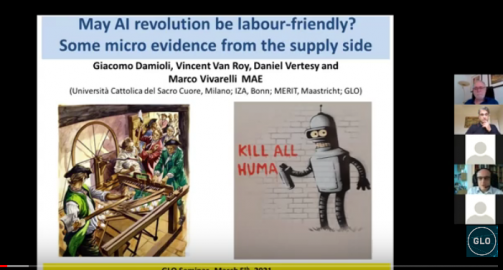
A new GLO Discussion Paper finds a positive and significant impact of AI patent families on employment, supporting the labour friendly nature of product innovation in the AI supply industries.
The Global Labor Organization (GLO) is an independent, non-partisan and non-governmental organization that functions as an international network and virtual platform to stimulate global research, debate and collaboration.
Author Abstract: This study investigates the possible job-creation impact of AI technologies, focusing on the supply side, namely the providers of the new knowledge base. The empirical analysis is based on a worldwide longitudinal dataset of 3,500 front-runner companies that patented the relevant technologies over the period 2000-2016. Obtained from GMM-SYS estimates, our results show a positive and significant impact of AI patent families on employment, supporting the labour friendly nature of product innovation in the AI supply industries. However, this effect is small in magnitude and limited to service sectors and younger firms, which are the leading actors of the AI revolution. Finally, some evidence of increasing returns seems to emerge; indeed, the innovative companies which are more focused on AI technologies are those obtaining the larger impacts in terms of job creation.
See also the recent GLO virtual Seminar on this paper: LINK
The Institute for Economic and Social Research (IESR) at Jinan University and the Global Labor Organization (GLO) are jointly organizing the Fourth IESR-GLO Virtual Conference. The conference this year will be held from June 24 (Thursday) to June 26 (Saturday), 2021 through Zoom. The theme is Social Safety Net and Welfare Programs. Robert Moffitt and Timothy Smeeding will be the keynote speakers.
The IESR-GLO annual conference is aimed to provide a platform for scholars and experts to exchange ideas on the current pressing economic issues through presentations of high-quality academic papers and policy discussions. Previous IESR-GLO Conferences have covered topics such as the Economics of Covid-19 in 2020 and on the Labor Markets in Belt and Road countries in 2019.
Submission
We welcome papers on topics related to Social Safety Net and Welfare Programs, especially social assistance programs.
Please submit a full paper or extended abstracts at
no later than 24:00 May 31, 2021 (Beijing Time, GMT+8).
The corresponding author will be notified of the decision by June 10, 2021.
No submission fee is required.
Keynote speakers
Robert Moffitt
Robert A. Moffitt is the Krieger-Eisenhower Professor of Economics at Johns Hopkins University and holds a joint appointment at the Johns Hopkins Bloomberg School of Public Health. He obtained his Ph.D. degree from Brown University. His research interests are in the areas of labor economics and applied microeconometrics, with a special focus on the economics of issues relating to the low-income population in the U.S.. A large portion of his research has concerned the labor supply decisions of female heads of family and its response to the U.S. welfare system. He has published on the AFDC, Food Stamp, and Medicaid programs.
Moffitt has served as Chief Editor of the American Economic Review, Coeditor of the Review of Economics and Statistics, Chief Editor of the Journal of Human Resources, and as Chair of the National Academy of Sciences Panel to Evaluate Welfare Reform. He is currently editor of Tax Policy and the Economy.
Moffitt is also a Fellow of the Econometric Society, a Fellow of the Society of Labor Economists, a member of the National Academy of Sciences, a recipient of a MERIT Award from the National Institutes of Health, a recipient of a Guggenheim Fellowship, a Fellow of the American Academy of Arts and Sciences, and Past President of the Population Association of America.
Timothy Smeeding
Timothy Smeeding is Lee Rainwater Distinguished Professor of Public Affairs and Economics of the University of Wisconsin–Madison. He obtained his Ph.D. in Economics from the University of Wisconsin–Madison. He was director of the Institute for Research on Poverty from 2008–2014 and was the founding director of the Luxembourg Income Study from 1983-2006. He was named the John Kenneth Galbraith Fellow, American Academy of Political and Social Science in 2017.
Professor Smeeding’s recent work has been on social and economic mobility across generations, inequality of income, consumption and wealth, and poverty in national and cross-national contexts.
His recent publications include: SNAP Matters: How Food Stamps Affect Health and Well Being (Stanford University Press, 2015); Monitoring Social Mobility in the 21st Century (Annals of the American Academy of Political and Social Science, 2015); From Parents to Children: The Intergenerational Transmission of Advantage (Russell Sage Foundation, 2012); Persistence, Privilege and Parenting: The Comparative Study of Intergenerational Mobility (Russell Sage Foundation, 2011); The Handbook of Economic Inequality (Oxford University Press, 2009); Poor Kids in a Rich Country: America’s Children in Comparative Perspective (Russell Sage Foundation, 2003); and The American Welfare State: Laggard or Leader?, (Oxford University Press, 2010).
Klaus F. Zimmermann, GLO Shuaizhang Feng, Jinan University Sen Xue, Jinan University
Contact
For inquiries regarding the conference, please contact Sen Xue at sen.xue@jnu.edu.cn. General inquiries regarding the submissions should be directed to iesrjnu@gmail.com.
Posted inEvents, News, Research|Comments Off on Fourth IESR-GLO Conference on ‘Social Safety Net and Welfare Programs’ with Robert Moffitt & Timothy Smeeding (June 24-26)
A new paper published ONLINE FIRST with free OPEN ACCESSdocuments a harming effect of the Fox News Channel in the United States on physical distancing during the COVID-19 pandemic.
The Global Labor Organization (GLO) is an independent, non-partisan and non-governmental organization that functions as an international network and virtual platform to stimulate global research, debate and collaboration.
Author Abstract: We document a causal effect of conservative Fox News Channel in the United States on physical distancing during COVID-19 pandemic. We measure county-level mobility covering all U.S. states and District of Columbia produced by GPS pings to 15-17 million smartphones and zip-code-level mobility using Facebook location data. Then, using the historical position of Fox News Channel in the cable lineup as the source of exogenous variation, we show that increased exposure to Fox News led to a smaller reduction in distance traveled and smaller increase in the probability to stay home after the national emergency declaration in the United States. Our results show that slanted media can have a harmful effect on containment efforts during a pandemic by affecting people’s behaviour.
Posted inNews, Research|Comments Off on Pandemic Responses in the Era of Fox News. Article on the media impact on Covid performance in the Journal of Population Economics.
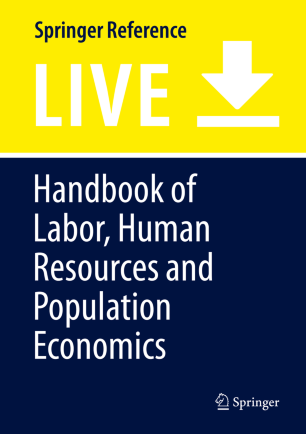
The Handbook in “Labor, Human Resources and Population Economics” provides an integrated picture of knowledge about the economic and social behaviors and interactions of human beings on markets, in households, in companies and in societies.A fast evolving project by the GLO with a core basis in labor economics, human resources, demography and econometrics, it will provide a large and complete summary and evaluation of the scientific state of the art. Chapters are developed under the guidance of an engaged team of editors led by the GLO President administered in 30 sections.
to find out how to contribute to this exciting venture with an own chapter.
The Section “Technological Changes and the Labor Market” is directed by Marco Vivarelli, who is also the GLO Cluster Lead of the “Technological Change” area.The Section is just completing its set of 20 published papers now available for use, review and debate.List of the articles and links to access them are below.
The Handbook of Labor, Human Resources and Population Economics Editor: Klaus F. Zimmermann
Section – Technological Changes and the Labor Market Marco Vivarelli, Section Editor Università Cattolica del Sacro Cuore Department of Economic Policy, Milan, Italy
Marco Vivarelli
Note: Find abstract links of the articles below the chapter titles.
Digitization and the Future of Work: Macroeconomic Consequences Melanie Arntz1,2, Terry Gregory3,1, Ulrich Zierahn5,1,4 1 Leibniz Centre for European Economic Research, 2University of Heidelberg, 3Institute of Labor Economics, IZA,4CESifo Research Network, 5Utrecht University
Innovation, Employment, and the Business Cycle Bernhard Dachs1, Martin Hud2, Bettina Peters2,3 1AIT Austrian Institute of Technology, 2Leibniz Centre for European Economic Research, 3University of Luxembourg
Why do employees participate in innovations? Skills and organisational design issues and the ongoing technological transformation, in production Nathalie Greenan, Silvia Napolitano Conservatoire National des Arts et Métiers
Quantity and Quality of Work in the Platform Economy Francesco Bogliacino1, Cristiano Codagnone2,3, Valeria Cirillo4, Dario Guarascio5 1Universidad Nacional de Colombia, 2Università degli Studi di Milano, 3Universitat Oberta de Catalunya, 4INAPP, National Institute for the Analysis of Public Policies, 5Università degli Studi di Roma
Integration in Global Value Chains and Employment Filippo Bontadini1, Rinaldo Evangelista2, Valentina Meliciani3, Maria Savona1 1University of Sussex, 2University of Camerino, 3University Luiss Guido Carli
Posted inNew Book, News, Research|Comments Off on Section “Technological Changes and the Labor Market” of the Handbook in “Labor, Human Resources and Population Economics” now available online.
A new GLO Discussion Paper finds a large number of over-educated workers with secondary and university level qualifications.
The Global Labor Organization (GLO) is an independent, non-partisan and non-governmental organization that functions as an international network and virtual platform to stimulate global research, debate and collaboration.
Author Abstract: This study examines the impact that over-education has on the earnings of private and public sector workers in Trinidad and Tobago. Using individual person’s data from the Continuous Sample Survey of the Population (CSSP) for the period 1991-2015, the returns of over-educated workers is estimated using a simple Quantile Regression approach. The labour force comprises of a large amount of over-educated workers who hold secondary and university level qualifications. The returns of workers employed in high-income jobs seems to be falling throughout the entire 1991-2015 period, while that of low and middle-income workers improved during 2004-2009 but declined thereafter the 2010-2015 as Trinidad and Tobago entered an economic recession. In addition, even though the wage returns of over-educated men, improves over the wage distribution, those in low and high-income jobs degenerated consistently throughout the 1991-2015 period. When compared to that of women, the opposite is true as their returns tends to worsen across much of the wage distribution. With any improvement being observed during 1991-2009 by low-income women.
A new GLO Discussion Paper investigates whetherthe socio-economic disadvantages that platform workers are likely to face are primarily channeled through lower incomes or more precarious working conditions.They are primarily students and face greater economic insecurity relative to all other occupations.
The Global Labor Organization (GLO) is an independent, non-partisan and non-governmental organization that functions as an international network and virtual platform to stimulate global research, debate and collaboration.
Author Abstract: The emergence of the platform economy has served as a defining feature of increasing fragmented labour markets in modern economies. Recent research on platform work, however, has struggled to quantify the socio-economic conditions of platform workers relative to other occupation groups. Moreover, it remains unclear if the socio-economic disadvantages that platform workers are likely to face are primarily channeled through lower incomes or their more precarious working conditions. This study uses representative survey data of platform workers in Italy to investigate their size, composition, and socio- economic conditions relative to individuals in other occupations. Our findings reveal that platform workers tend to be students and of younger age, but are diverse with respect to sex, educational attainment, and native-born status. We find that platform workers face greater economic insecurity relative to all other occupation classes. Strikingly, they also feature a rate of economic insecurity that is not significantly different from that of unemployed adults. Moreover, we find that the higher levels of insecurity are not primarily channeled through lower incomes; instead, higher rates of insecurity persist even when taking family incomes into account, suggesting that the precarity and volatility of platform work matter as much as income differences in shaping economic disadvantage. Results hold under analyses that account for selection into platform work. Our findings carry important consequences for understandings of the intensity and sources of socio- economic disadvantage of individuals engaged in platform work.
A new GLO Discussion Paper demonstrates how immigrant men following the 1965 Immigration and Nationality Act in the United States have low initial earnings and high earnings growth after all.A re-visit of an influential debate in migration economics.
The Global Labor Organization (GLO) is an independent, non-partisan and non-governmental organization that functions as an international network and virtual platform to stimulate global research, debate and collaboration.
Author Abstract: Two radically different descriptions of immigrant earnings trajectories in the U.S. have emerged. One asserts that immigrant men following the 1965 Immigration and Nationality Act have low initial earnings and high earnings growth. Another asserts that post-1965 immigrants have low initial earnings and low earnings growth. We describe the methodological issues that create this divide and show that low earnings growth becomes high earnings growth when immigrants are followed from their initial years in the U.S., earnings growth is allowed to vary with entry earnings, and-when following cohorts instead of individuals-sample restrictions commonly used by labor economists are avoided.
A new GLO Discussion Paper finds that the recent adoption of a two-child policy in China has substantially increased the number of second-child births.
The Global Labor Organization (GLO) is an independent, non-partisan and non-governmental organization that functions as an international network and virtual platform to stimulate global research, debate and collaboration.
Author Abstract: This study examines the consequences of relaxing birth quotas by exploiting an exogenous two-child policy adopted by local Chinese governments on different dates. Using China’s 2015 population census combined with a difference-in-differences framework, we find that the adoption of a two-child policy substantially increases the number of second-child births. The impact of the policy is more pronounced among couples who have higher fertility preferences and who are less sensitive to child-rearing costs. At the same time, this policy substantially decreases the number of first-child births. Child-rearing costs are a likely underlying mechanism for this decrease. All of these findings are in line with an extended Barro-Becker model.