Comparative Economics meets new global policy challenges and research questions

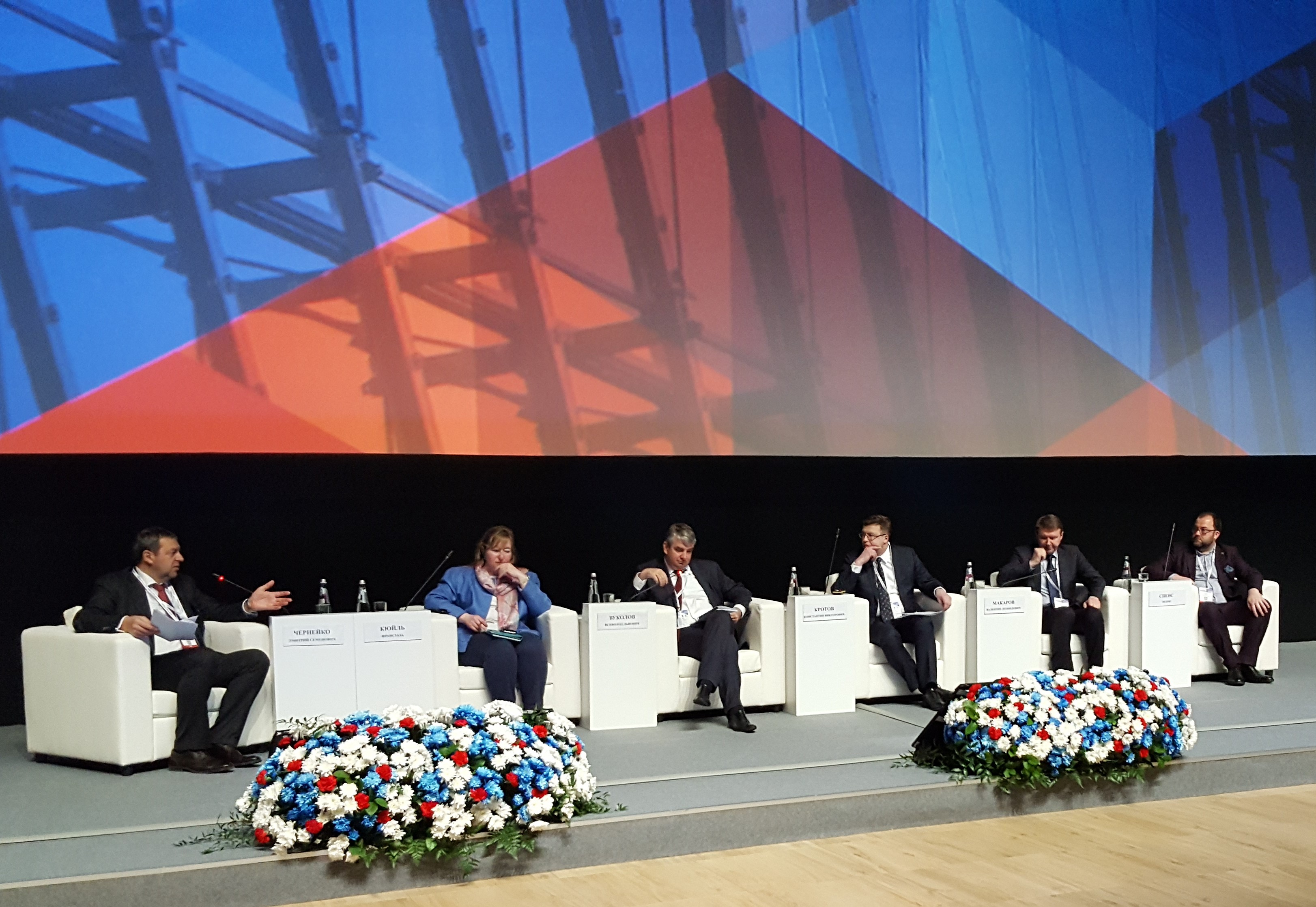
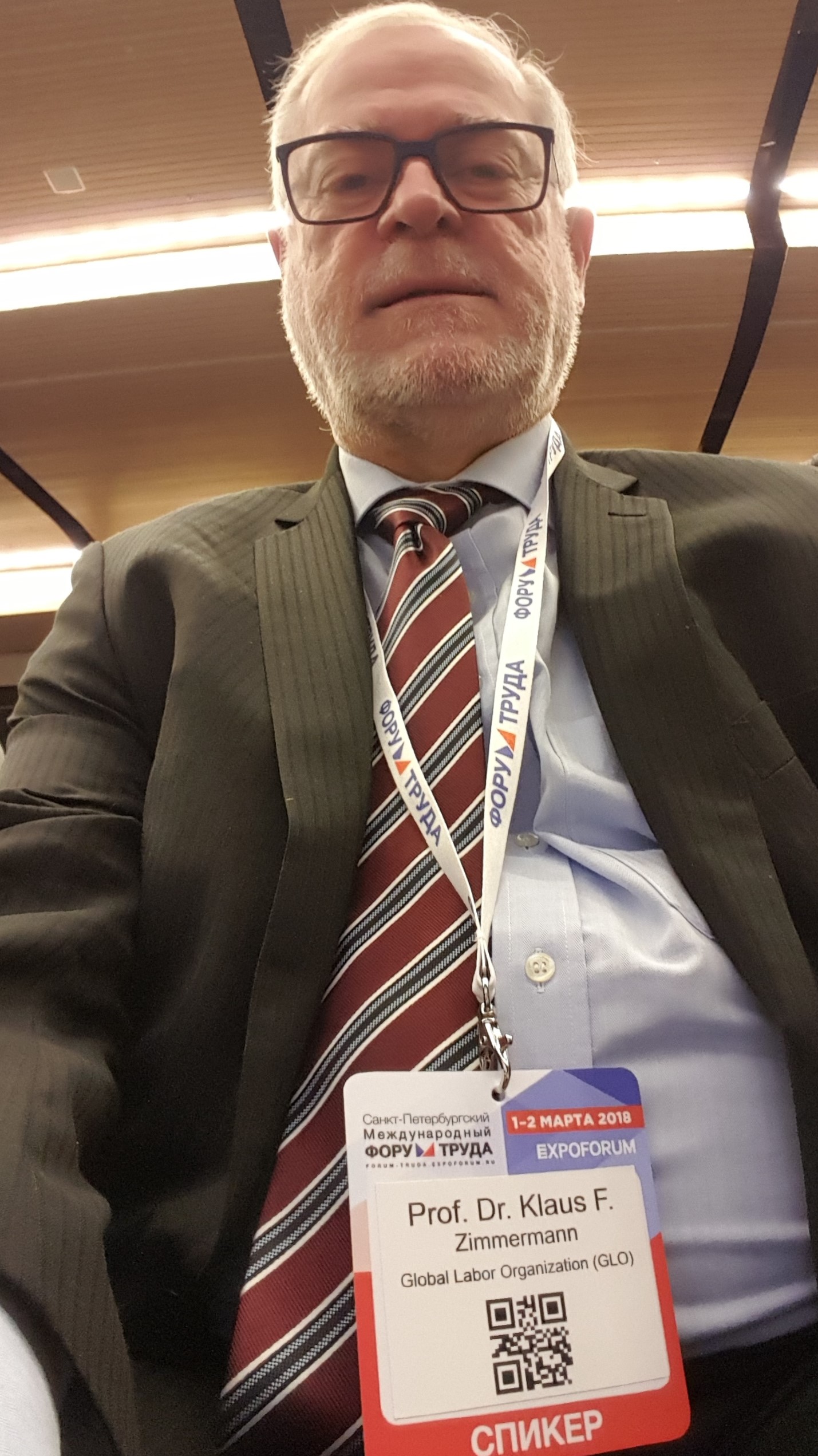
The world is at the beginning of a new phase of global challenges. Posting from St Petersburg in the morning after President Putin’s recent national speech, I would like to share with you an interview with GLO Fellow Nauro Campos on Comparative Economics published also on the GLO (Global Labor Organization) blog.

Nauro Campos, Professor of Economics at Brunel University London and Research Professor at ETH-Zürich, has recently been appointed Editor of the prominent research journal Comparative Economic Studies. Prof. Campos works with a new Editorial Board. I have asked him about his perspectives for this challenging new role.

KFZ: Soviet studies, transition economics, new global challenges: What is Comparative Economics today?

Nauro Campos: Comparative economics is today in the cusp of becoming, once again, a really vibrant and exciting research area. Think of institutions 20 years ago, or economic history 10 years ago, and that gives you an idea where comparative economics is today. The Comparative Economic Studies journal (CES) tries to reflect that. It welcomes both submissions that are obviously comparative and case studies of single countries or of regions. It is looking for papers that investigate how economic systems respond to economic structural changes and crises, whether these are brought about by globalization, demographics, institutions, technology, politics, and/or the environment. CES is an economics journal, but is one that openly welcomes contributions from political scientists, historians and sociologists, to name a few selected disciplines.  In order to accommodate these aspirations, the new Editorial team has broadened the journal’s regional focus and has changed its mission and objectives accordingly.

KFZ: Did you change the regional focus of Comparative Economic Studies?

Nauro Campos: Yes. CES is a journal of the Association of Comparative Economic Studies which when it started out, in the Cold War years of the 1960s to 1980s, was mostly concerned with what one may call “issues of the Soviet economy.” After the fall of the Berlin Wall, CES became a crucial outlet for work on the transition away from central planning. It focused on the Central European and the Former Soviet Union countries.  While working hard to maintain this prominent position, the regional focus and scope of CES has now been further enlarged to encompass other areas as well. There is a lot of interest in comparative economics today in European Union as a whole and the journal is very attentive to that. Moreover, the scope has been even further broadened to include studies about Asian, Latin American, and African experiences.

KFZ: How will you combine research articles with the mission to connect Comparative Economic Studies to important policy debates?

Nauro Campos: As I said, the new editorial team has made some substantial changes in the mission of the journal as well as on its more specific goals. The overall idea is to move the journal, slowly but surely, towards it becoming an outlet in the mould of the Journal of Economic Perspectives. Think of it as a JEP-style comparative economics outlet; that is what the journal wants to be in the medium-term. We want to publish papers that offer original political economy analysis from a comparative perspective. Papers that are a truly accessible source for state-of-the-art comparative economics thinking. Articles that genuinely encourage cross-fertilization of ideas from various disciplines and that are the forefront of the debate of the directions for future research in comparative studies. But we also want papers that provide materials and insights that become useful and relevant for teaching, for the public policy debate and for the media. This change makes CES quite unique, so we will not be competing with other journals but mostly complementing their work, and the link to policy and to policy debates should become quite natural and hopefully quite strong.

KFZ: Thank you very much and good luck with your new venture!

Professor Nauro Campos

Bio note:  Nauro Campos is Professor of Economics at Brunel University London and Research Professor at ETH-Zürich. Previously he taught at the Universities Paris 1 Sorbonne, Newcastle, CERGE-EI and Warwick. He was a Fulbright Fellow at Johns Hopkins and Robert McNamara Fellow. He received his Ph.D. from the University of Southern California (Los Angeles) in 1997, where he was lucky enough to learn about institutions from Jeff Nugent and Jim Robinson and (more than) happy to be Dick Easterlin’s RA for three years.

Note: KFZ is Klaus F. Zimmermann, UNU-MERIT, Maastricht University and President of the Global Labor Organization.

Ends;
Posted in Media, Research | Comments Off on Comparative Economics meets new global policy challenges and research questions

Vienna: Meeting with Austrian Business about the need of a flexible and free European labor market

Klaus F. Zimmermann (UNU-MERIT, Maastricht University and Bonn University) is the President of the Global Labor Organization (GLO). On February 26, 2018, he participated in a conference of the Austrian Federal Economic Chamber, in Vienna/Austria on the “The European Labor Market – between Unemployment and Shortages of Skilled Labor”. Zimmermann gave a speech on “Challenges and Chances of the free European Mobility of Workers” and participated on a Plenary Panel about the labor markets of Austria, Poland and Romania. He had many interactions with participants, among others with Christoph Leidl, the President of the Austrian Federal Economic Chamber, and GLO Fellow Rainer Münz (European Political Strategy Centre, European Commission, Brussels).

Key messages of the speech of Zimmermann (Challenges and Chances of the free European Mobility of Workers):

► In the past, Austria was able to attract needed workers from the European Union member countries, in particular from the new member states in the East. However, the labor markets of Poland, Romania and the Czech Republic are empty and can hardly fulfill such needs in the future.

► EU – internal labor mobility is crucial for the welfare of Europe and Austria. Labor market flexibility is an important factor for economic prosperity. It helps to adjust to long term-demands and absorbs asymmetric economic shocks.

► EU labor market flexibility has recently increased in comparison with the US. This has been driven by migrants from the recent EU enlargement new member states, but also from third country nationals.

► Labor mobility demonstrates the advantages of migration for the receiving economies. It hence helps to reduce potential tensions against migrants in the native population.

Literature:

►Jauer, Julia & Liebig, Thomas & Martin, John P. & Puhani, Patrick A., Migration as an adjustment mechanism in the crisis? A comparison of Europe and the United States 2006-2016,  GLO Discussion Paper 178, February 2018. Free download.

Abstract: We estimate whether migration can be an equilibrating force in the labour market by comparing pre-and post-crisis migration movements at the regional level in both Europe and the United States, and their association with symmetric labour market shocks. Based on fixed-effects regressions using regional panel data, we find that Europe’s migratory response to unemployment shocks was almost identical to that recorded in the United States after the crisis. Our estimates suggest that, if all measured population changes in Europe were due to migration for employment purposes – i.e. an upper-bound estimate – up to about a quarter of the asymmetric labour market shock would be absorbed by migration within a year. However, in Europe and especially in the Eurozone, the reaction to a very large extent stems from migration of recent EU accession country citizens as well as of third – country nationals.

►Zimmermann, Klaus F., Migrationspolitik im Mediensturm (Migration Policy in the Media Storm), Wirtschaftspolitische Blätter, 63 (2016), 497-508. Pre-publication draft.

►Zimmermann, Klaus F., Migration, jobs and integration in Europe, in: Migration Policy Practice, 2014, 6(4), 4-16. Publication, free access.

►Bauer, Thomas K. & Lofstrom, Magnus & Zimmermann, Klaus F., Immigration policy, assimilation of immigrants, and natives’ sentiments towards immigrants: Evidence from 12 OECD countries, Swedish Economic Policy Review (2000) 7, 11-53. (497 Google Scholar Cites.)

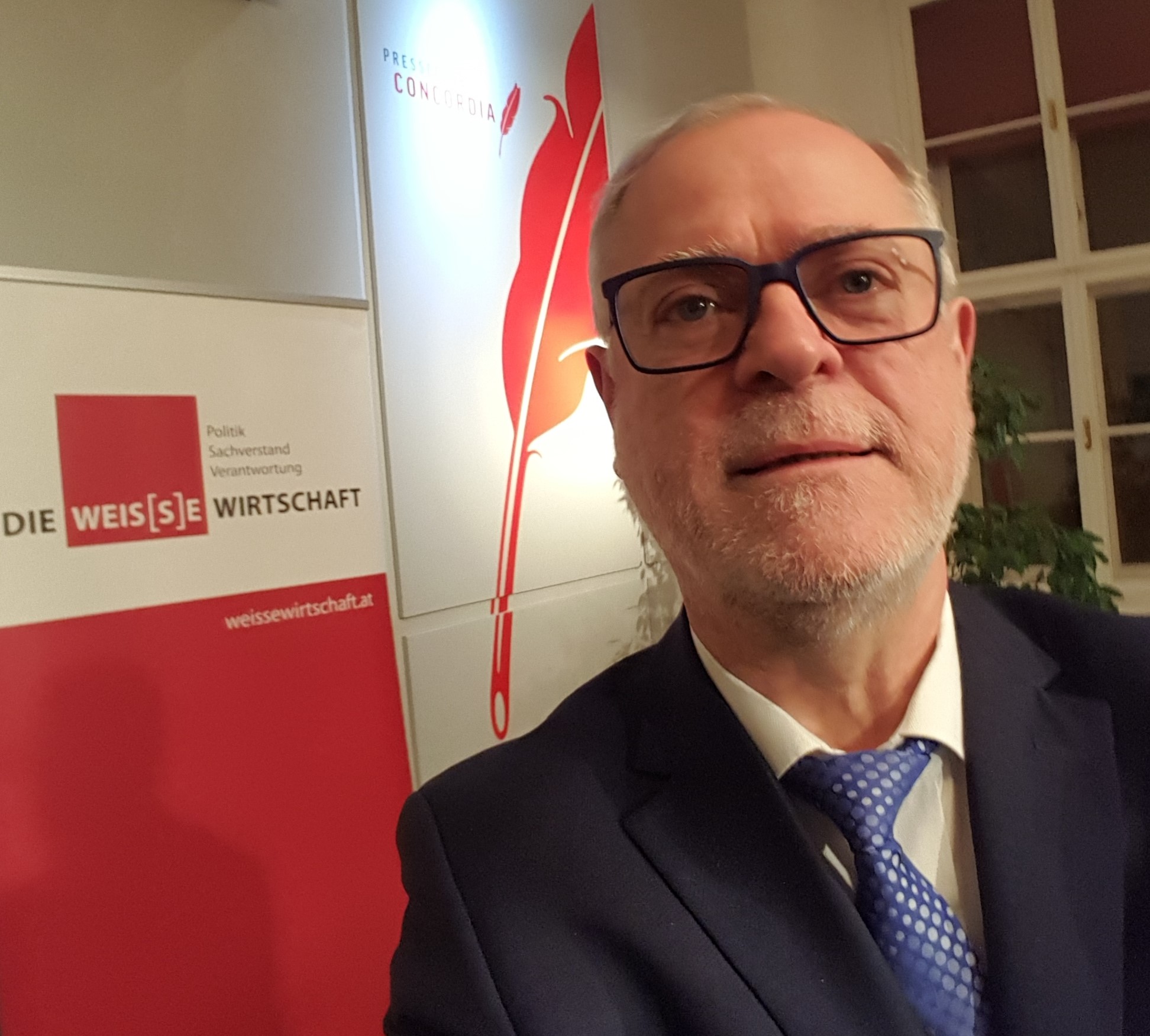
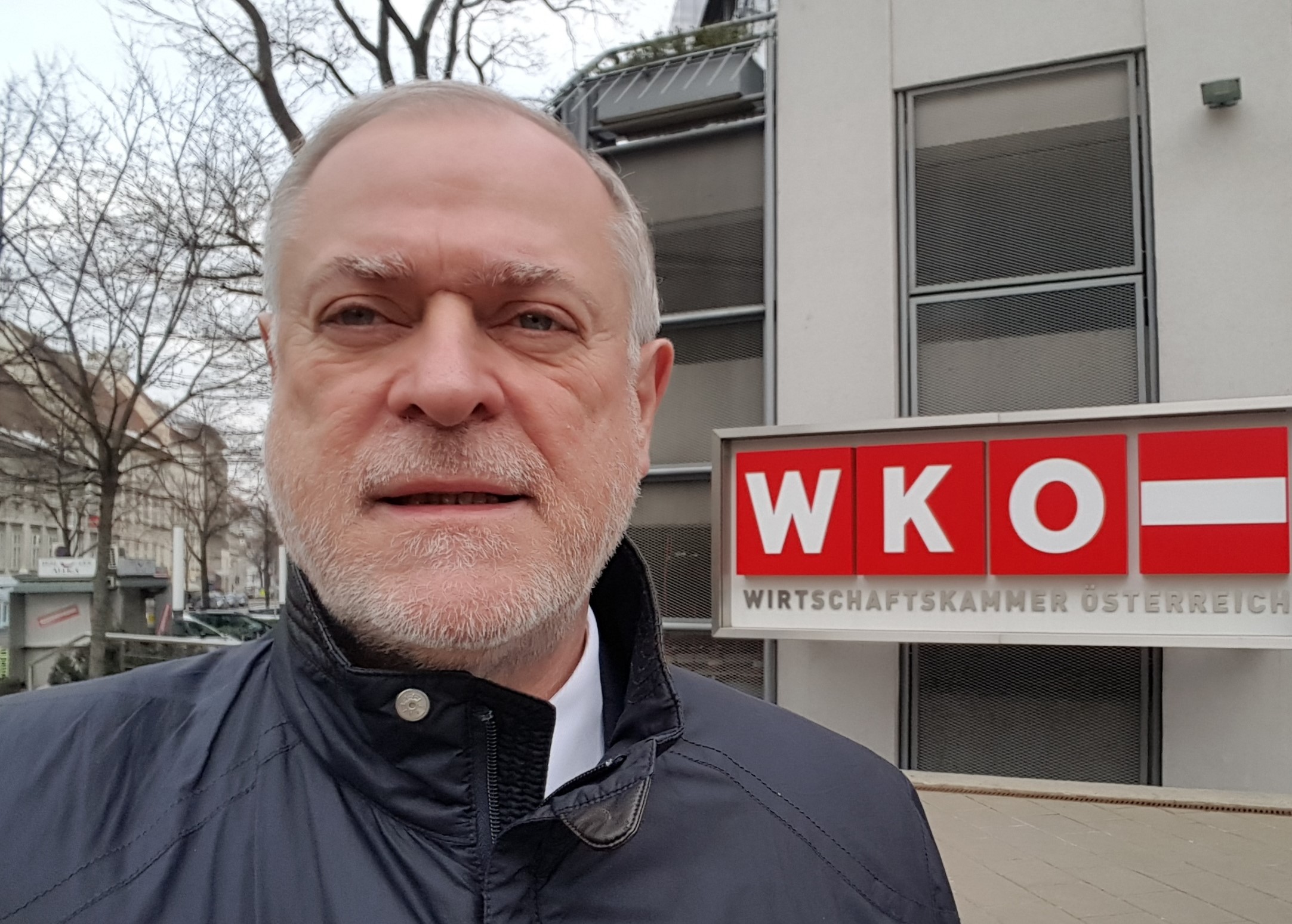
GLO President Zimmermann in front of the Austrian Federal Economic Chamber, Vienna, on February 26, 2018.

Ends;
Posted in Events, Policy, Research output | Comments Off on Vienna: Meeting with Austrian Business about the need of a flexible and free European labor market

GLO President on Contact Tour in Europe

The President of the Global Labor Organization (GLO), Klaus F. Zimmermann (UNU-MERIT, Maastricht University & Bonn University) is currently on a contact tour through Europe for talks, research seminar presentations and policy debates.

  • February 14 – 17, 2018: Nicosia and the University of Cyprus. See for more details.
  • February 21-22, 2018: Glasgow/Scotland and the University of Strathclyde. Contacts and Research Seminar presentation of Zimmermann on Arsenic water consumption and wellbeing in Bangladesh on the invitation of GLO Fellow Robert Wright and Markus Gehrsitz.
  • February 26, 2018: Austrian Federal Economic Chamber, Vienna/Austria: Conference on the “The European Labor Market – between Unemployment and Shortages of Skilled Labor”. Zimmermann gave a speech on “Challenges and Chances of the free European Mobility of Workers” and participated on a Plenary Panel about the labor markets of Austria, Poland and Romania. Many interactions, among others with Christoph Leidl, the President of the Austrian Federal Economic Chamber, and GLO Fellow Rainer Münz (European Political Strategy Centre, European Commission, Brussels).
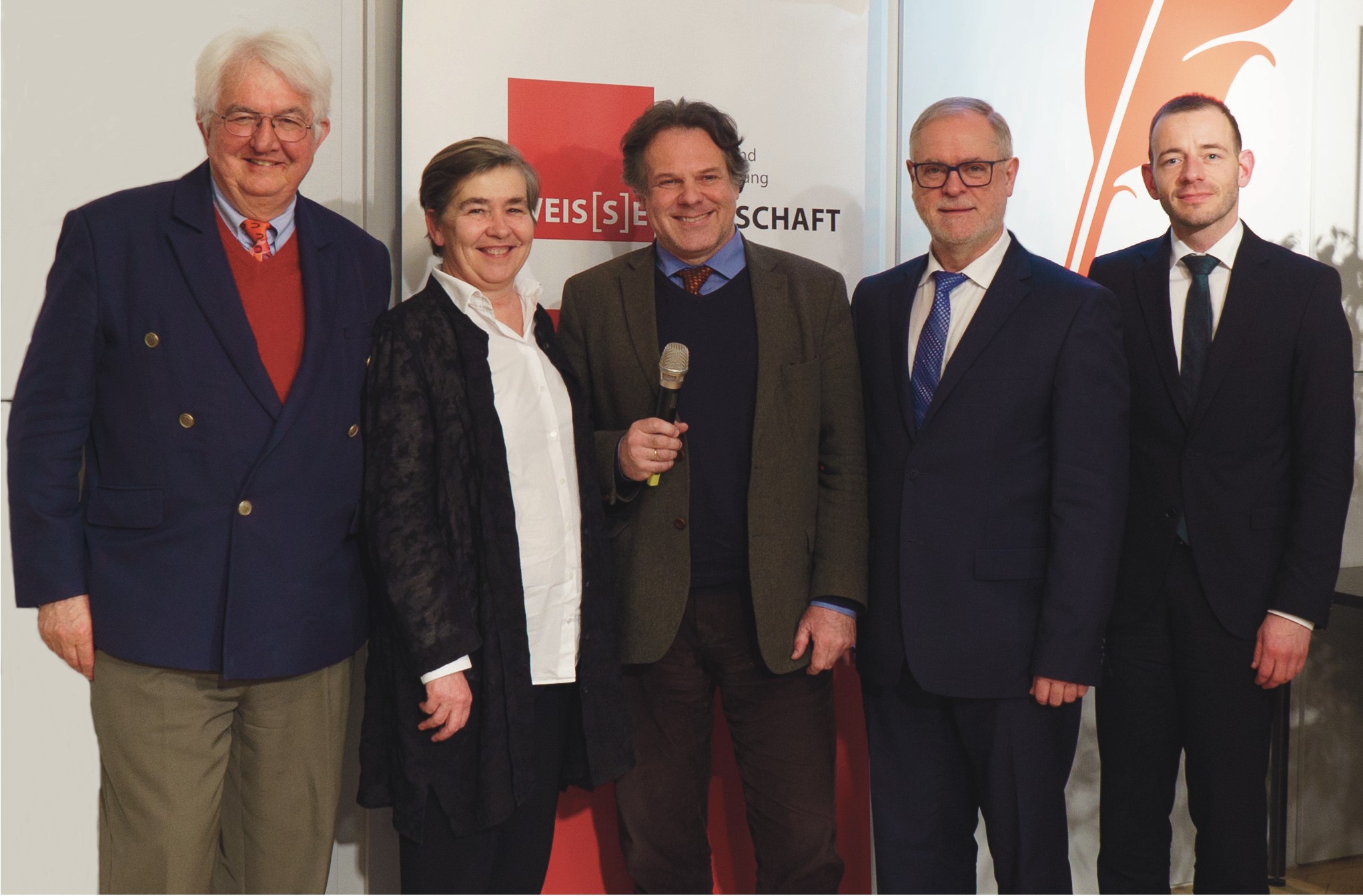
  • February 27, 2018: Policy Panel in Vienna/Austria of DIE WEIS[S]E WIRTSCHAFT in the Press Center Concordia on Migration and Integration Policy of the new Austrian Government. Panel organized by GLO Fellow Peter Brandner. Zimmermann discusses among others with GLO Fellow Robert Holzmann.
  • March 1 -2, 2018: St Petersburg/Russia. Zimmermann speaks on the Second International Labour Forum of the Government of St. Petersburg on “The design of effective labor market policies“.

Zimmermann in a taxi in Glasgow on his way to the airport.

Ends;
Posted in Events, Policy, Research | Comments Off on GLO President on Contact Tour in Europe

Reminder: EBES-GLO-FOM Conference in Berlin Deadline February 28 for Submissions!

Call for Papers
25th EBES Conference – Berlin
May 23-25, 2018
Berlin, Germany

Jointly organized with the GLO (The Global Labor Organization)
and hosted by the FOM University of Applied Sciences

Deadline: February 28, 2018
You are cordially invited to submit your abstracts or papers for presentation consideration at the 25th EBES Conference. The conference will be jointly organized with the GLO (The Global Labor Organization) and will take place on May 23th, 24th, and 25th, 2018 at the FOM University of Applied Sciences in Berlin, Germany with the support of the Istanbul Economic Research Association.
The conference aims to bring together many distinguished researchers from all over the world. Participants will find opportunities for presenting new research, exchanging information, and discussing current issues. Although we focus on Europe and Asia, all papers from major economics, finance, and business fields – theoretical or empirical – are highly encouraged.
Keynote Speakers
  • Prof. Klaus F. Zimmerman, UNU-MERIT, Maastricht University, The Netherlands
  • Prof. Marco Vivarelli, Università Cattolica Del Sacro Cuore, Italy
  • Prof. Sascha Frohwerk, the FOM University of Applied Sciences in Berlin, Germany
  • Prof. Ahmet Faruk Aysan, Istanbul Sehir University, Turkey
Board
  • Prof. Jonathan Batten, Monash University, Australia
  • Prof. Iftekhar Hasan, Fordham University, U.S.A.
  • Prof. Peter Rangazas, Indiana University-Purdue University Indianapolis, U.S.A.
  • Prof. Euston Quah, Nanyang Technological University, Singapore
  • Prof. John Rust, Georgetown University, U.S.A.
  • Prof. Marco Vivarelli, Università Cattolica Del Sacro Cuore, Italy
  • Prof. Klaus F. Zimmermann, UNU-MERIT, Maastricht University, The Netherlands
Abstract/Paper Submission

Authors are invited to submit their abstracts or papers no later than February 28, 2018. For submission, please visit our website at: http://ebesweb.org/Conferences/25th-EBES-Conference-Berlin/Abstract-Submission.aspx. No submission fee is required. General inquiries regarding the call for papers should be directed to ebes@ebesweb.org.
Publication Opportunities
  • Qualified papers will be published in the EBES journals (Eurasian Business Review and Eurasian Economic Review). EBES journals are published by Springer and indexed in the Scopus, Emerging Sources Citation Index (Thomson Reuters), EconLit, EBSCO Discovery Service, ProQuest, ABI/INFORM, Business Source, International Bibliography of the Social Sciences (IBSS), OCLC, Research Papers in Economics (RePEc), Summon by ProQuest, TOC Premier, Cabell’s Directory, Ulrich’s Periodicals Directory, and Google Scholar. There is no submission and publication fee for EBES journals.
  • All accepted abstracts will be published electronically in the Conference Program and the Abstract Book (with an ISBN number). It will be distributed to all conference participants at the conference via USB. Although submitting full papers are not required, all the submitted full papers will also be included in the conference proceedings in the USB.
  • After the conference, participants will also have the opportunity to send their paper to be published in the Springer’s series Eurasian Studies in Business and Economics (no submission and publication fee). This will also be sent to Thomson Reuters in order to be reviewed for coverage in its Conference Proceedings Citation Index. Please note that the 10th, 11th, 12th, 13th, 14th, 15th, 16th, and 17th EBES Conference Proceedings are accepted for inclusion in the Conference Proceedings Citation Index. 18th and subsequent conference proceedings are in progress.

Important Dates

  • Submission deadline: February 28, 2018
  • Reply-by: March 8, 2018
  • Registration deadline: April 20, 2018
  • Announcement of the Program: April 30, 2018

Contact

 
Ends;
Posted in Events, Media | Comments Off on Reminder: EBES-GLO-FOM Conference in Berlin Deadline February 28 for Submissions!

Marriage Delays and Earnings: Insights from an Interview with Professor Le Wang of the University of Oklahoma

The prestigious 2018 Kuznets Prize of the Journal of Population Economics has been awarded to Chunbei Wang and Le Wang of the University of Oklahoma. The prize has been presented at a recent event of the Global Labor Organization (GLO) in Washington DC. Chunbei Wang and Le Wang of the University of Oklahoma have received the 2018 Kuznets Prize for their article “Knot yet: Minimum marriage age law, marriage delay, and earnings,” which was published in the Journal of Population Economics (2017), 30(3), pp. 771-804. The annual prize honors the best article published in the Journal of Population Economics in the previous year.


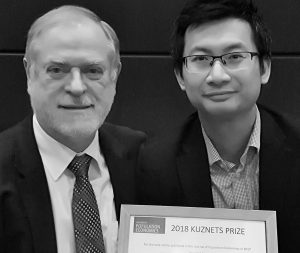
GLO Fellow Le Wang of the University of Oklahoma (right) and Klaus F. Zimmermann (GLO President and Editor-in-Chief of the Journal of Population Economics.)

Background questions to GLO Fellow Professor Le Wang:

Le Wang, your research suggests that there is an earnings premium of marriage delays which is larger for females than for males. This causal effect seems to work almost exclusively through more education for both men and women. 
 
GLO: Marrying later generates higher incomes: You say it is “causal”, what does this mean in your context and why is it important?
Le Wang: We often observe that people who marry later also earn higher earnings. This positive association, however, may not necessarily imply that delaying marriages would necessarily lead to higher productivity or higher earnings. It may be simply due to the fact that people who delay their marriages may be different from those who do not. For example, people who delay marriages may be more career oriented or motivated, and thus these people are more likely to have higher earnings, whether they delay marriage or not. By “causal”, we mean that we are actually able to isolate the productivity-enhancing effects of marriage delay. This result has important policy implications because if we can somehow “cause” or induce people to delay their marriages, we could increase their earnings.
GLO: What are the policy implications, who can “cause” marriage delays and make couples richer?
Le Wang: Government can, for example, institute minimum marriage age laws (the differences in such laws across states were also the reason why we can identify the causal impacts of marriage delay). There are also other examples in which rather than regulating the minimum marriage age, governments can provide incentives for people to marry late. For example, Chinese government implemented the “late marriage leave” that allowed workers who get married at age 25 or older to take a 30-day paid leave when getting married.
GLO: Research in the gender-equality literature argues that the more females work full-time, the lower the gender wage gap. What implications do your findings have for this debate?
Le Wang: Much of the gender gap literature has been focused on whether and how human capital characteristics and discrimination can explain the gap. Our results highlight the potential role of family in explaining it. Over the past decades, there have been similar changes in the median age of first marriage between men and women. In light of our findings, such demographic trends could have much greater impacts on women’s earnings, thereby leading to the narrowing gender gap.


Ends;
Posted in Events, Media, Policy, Research | Comments Off on Marriage Delays and Earnings: Insights from an Interview with Professor Le Wang of the University of Oklahoma

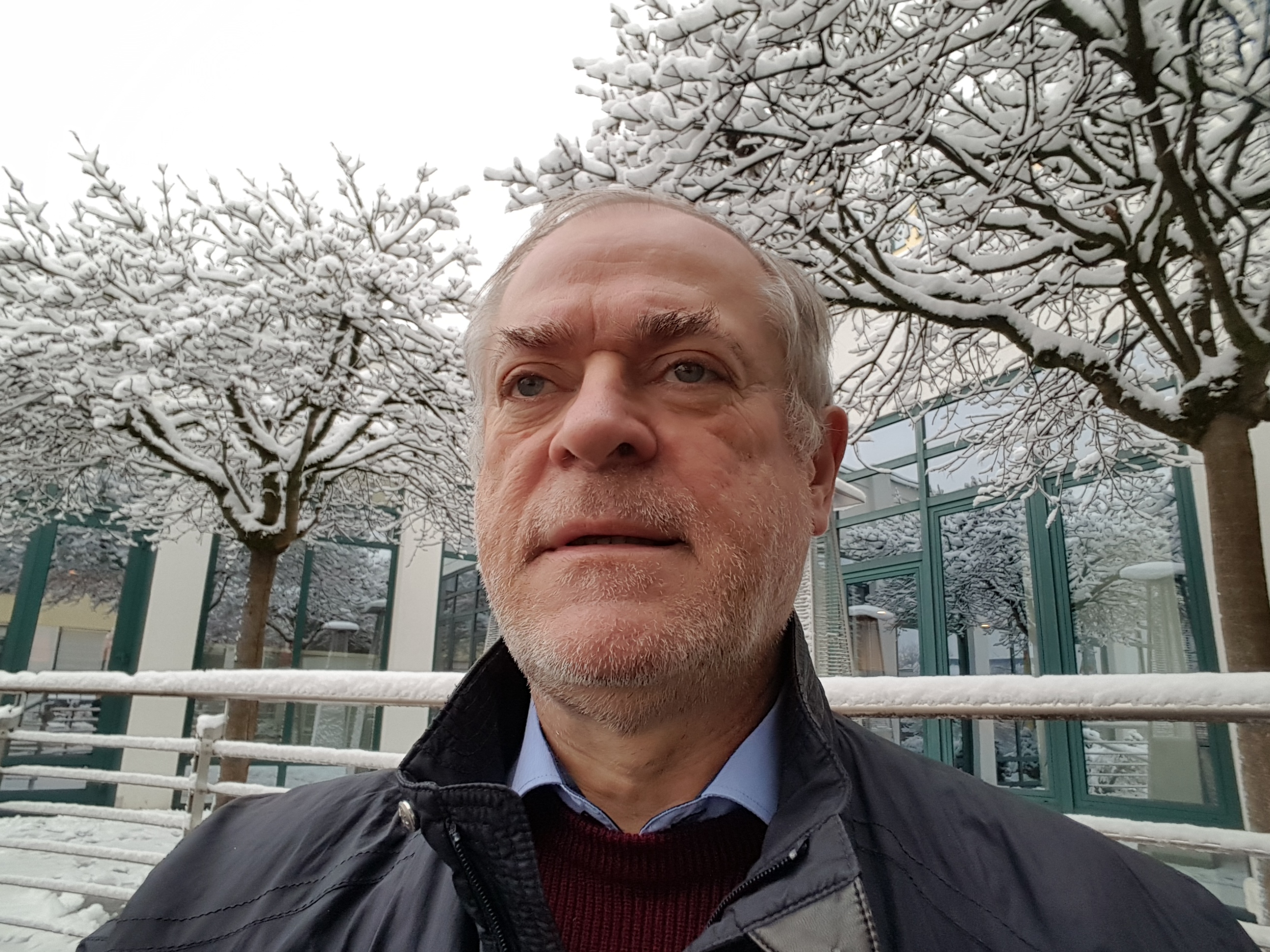
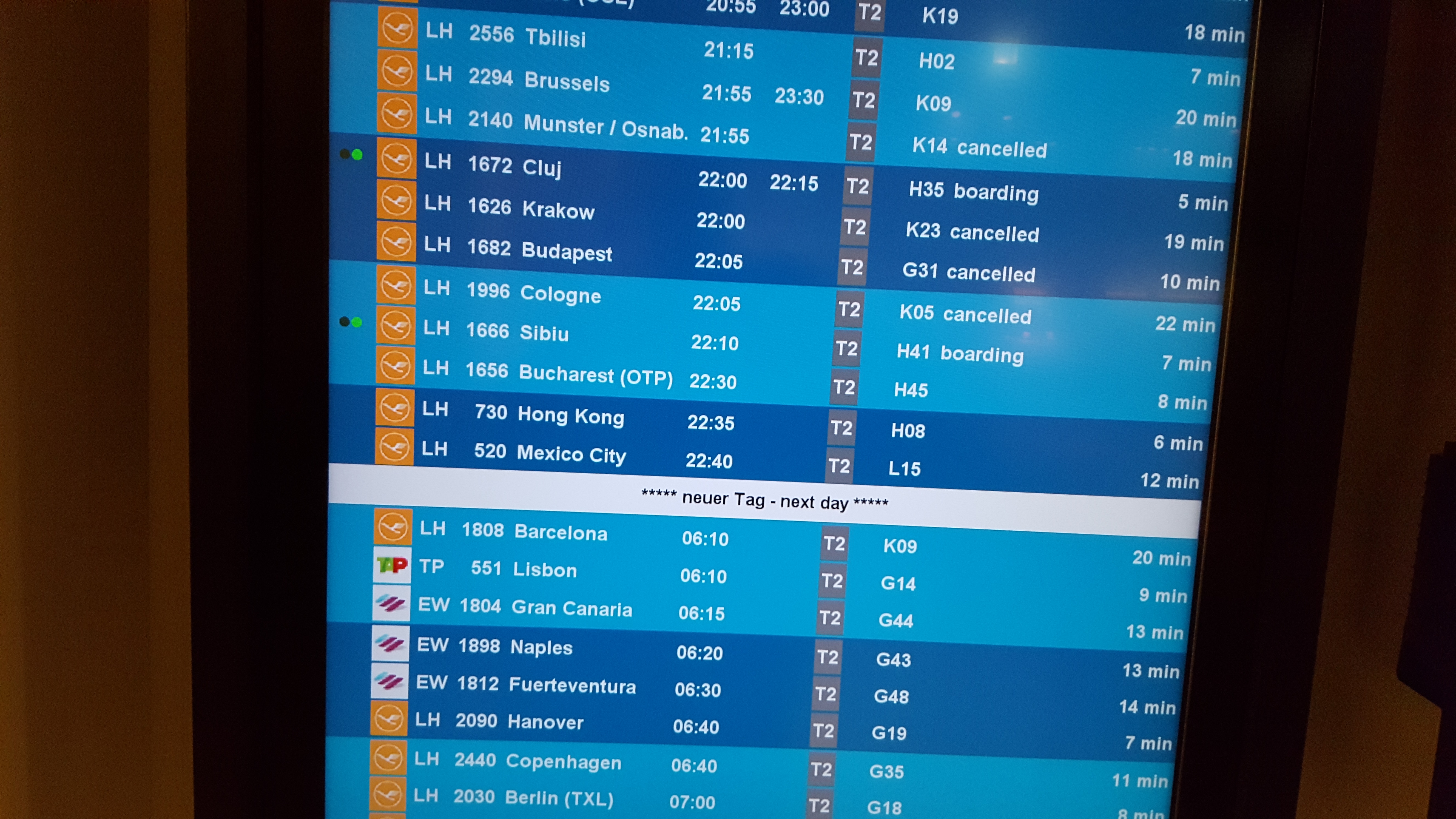
Stranded in Munich: Snowfall delayed return to Bonn/Cologne

On his way back to Cologne from his visit to Cyprus, GLO President Klaus F. Zimmermann had to relax during an unplanned overnight stay in Munich February 17 to 18. Caused by heavy snowfall, his connection flights were canceled twice.

Zimmermann had been Professor and Chair-holder at the University of Munich for one decade (1989−1998) and excellent memories of a lovely city. He enjoyed the rest and Bavarian hospitality in the middle of a chaotic traffic situation.


Ends;

Posted in Events | Comments Off on Stranded in Munich: Snowfall delayed return to Bonn/Cologne

Visiting University of Cyprus and Nicosia

In evaluation missions, #GLO President Klaus F. Zimmermann (UNU-MERIT, Maastricht University & Bonn University) has visited Nicosia and its University of Cyprus on February 14 – 17, 2018 for intensive talks and learning. He has also been frequently on both sides of the Nicosia inner city border and the UN Buffer Zone.

Zimmermann at the Metehan Border Crossing

Zimmermann in the Selimiye Mosque

Zimmermann at the University of Cyprus, working in the Department of Economics

Ends;

Posted in Events, Media, Policy, Travel | Comments Off on Visiting University of Cyprus and Nicosia

Carnival 2018 — Open to Debate

Back from Washington DC — now meeting with GLO friends in the Cologne-Bonn region.

Cologne Carnival 2018 dates.

Ends;

Posted in Events, Media | Comments Off on Carnival 2018 — Open to Debate

GLO President Klaus F. Zimmermann advises the Inter-American Development Bank in Washington DC

Migration between South America and the United States has become an issue of rising interest. In this context, a project supported by the Inter-American Development Bank (IDB) has highest importance that investigates, documents and analyzes the international migration dynamics in Mexico, Central America and the Dominican Republic. It studies the labor markets, economic integration and migration in the Central American region, fiscal impacts of migration, and the role of remittances. Of particular interest are case studies on Mexico, Costa Rica, Panama, the Northern Triangle and US-Mexican migration.

As part of a team of advisors Klaus F. Zimmermann (UNU-MERIT, Maastricht University and Bonn University), who is also the President of the Global Labor Organization (GLO), has visited the Headquarters of the IDB on February 9, 2018. A number of analysts supporting this important research project are GLO Fellows and were also present in the intensive all-day workshop. Results of the research will be made available in summer 2018.

Zimmermann in front of the bank in Washington DC.

Ends;

Posted in Events, Policy, Research | Comments Off on GLO President Klaus F. Zimmermann advises the Inter-American Development Bank in Washington DC

Kuznets Prize Dinner with Le Wang of the University of Oklahoma in Washington DC

The Kuznets Prize is a prestigious scientific award given by the Journal of Population Economics for the best paper published in the Journal. The Kuznets Prize 2018 has been awarded to Chunbei Wang and Le Wang of the University of Oklahoma for their article:

Knot yet: Minimum marriage age law, marriage delay, and earnings

The article was published in the Journal of Population Economics (2017), 30(3), pp. 771-804. (The article is freely accessible for one months after the dinner event. Just click on the title above. For all the details about the prize and the article content see also here.)

The Prize was presented at a dinner event of the Global Labor Organization (GLO) in Washington DC on February 8, 2018. In a ceremony, Le Wang received the Prize Certificate from the Editor-in-Chief of the Journal, Klaus F. Zimmermann, who is also the President of GLO.

After intensive talks: Dinner with the Kuznets Prize winner Le Wang:

From the left: Hai-Anh H. Dang (World Bank), Brian W. Sloboda (US Department of Labor), Barry Chiswick (George Washington University), Carmel Chiswick (George Washington University), Emmanuel Abuelafia (Inter-American Development Bank), Miryam Hazan (Inter-American Development Bank), Le Wang (Oklahoma University), Klaus F. Zimmermann (UNU-MERIT, Maastricht University & Bonn University) and Don Parsons (George Washington University).

Ends;

Posted in Events, Media | Comments Off on Kuznets Prize Dinner with Le Wang of the University of Oklahoma in Washington DC