Demographic Change induces Automation

A new GLO Discussion Paper reveals that countries with lower population growth introduce automation technologies faster.

The Global Labor Organization (GLO) is an independent, non-partisan and non-governmental organization that functions as an international network and virtual platform to stimulate global research, debate and collaboration.

GLO Discussion Paper No. 518, 2020

Automation and Demographic ChangeDownload PDF
by
Abeliansky, Ana Lucia & Prettner, Klaus

GLO Fellow Klaus Prettner

Author Abstract: We analyze the effects of declining population growth on automation. Theoretical considerations imply that countries with lower population growth introduce automation technologies faster. We test the theoretical implication on panel data for 60 countries over the time span 1993-2013. Regression estimates support the theoretical implication, suggesting that a 1% increase in population growth is associated with an approximately 2% reduction in the growth rate of robot density. Our results are robust to the inclusion of standard control variables, different estimation methods, dynamic specifications, and changes with respect to the measurement of the stock of robots.

Photo by Andy Kelly on Unsplash

GLO Discussion Papers are research and policy papers of the GLO Network which are widely circulated to encourage discussion. Provided in cooperation with EconStor, a service of the ZBW – Leibniz Information Centre for Economics, GLO Discussion Papers are among others listed in RePEc (see IDEAS, EconPapers). Complete list of all GLO DPs – downloadable for free.

Ends;

Posted in News, Research | Comments Off on Demographic Change induces Automation

Income inequality in the access to health care: Biomarkers, disability and health care demand

A new GLO Discussion Paper reveals that observed income inequality in the access to health care is driven by the fact that higher-income people tend to make greater use of healthcare treatment, for any given health and disability status.

The Global Labor Organization (GLO) is an independent, non-partisan and non-governmental organization that functions as an international network and virtual platform to stimulate global research, debate and collaboration.

GLO Discussion Paper No. 517, 2020

Biomarkers, disability and health care demandDownload PDF
by
Davillas, Apostolos & Pudney, Stephen

GLO Fellow Apostolos Davillas

Author Abstract: Using longitudinal data from a representative UK panel, we focus on a group of apparently healthy individuals with no history of disability or major chronic health condition at baseline. A latent variable structural equation model is used to analyse the predictive role of latent baseline biological health, indicated by a rich set of biomarkers, and other personal characteristics, in determining the individual’s disability state and health service utilisation five years later. We find that baseline health affects future health service utilisation very strongly, via functional disability as a mediating outcome. Our model reveals that observed income inequality in the access to health care, is driven by the fact that higher-income people tend to make greater use of healthcare treatment, for any given health and disability status. This leads to a slight rise in utilisation with income, despite the lower average need for treatment shown by the negative income gradients for both baseline health and disability outcomes. Factor loadings for latent baseline health show that a broader set of blood-based biomarkers, rather than the current focus mainly on blood pressure, cholesterol and adiposity, may need to be considered for public health screening programs.

GLO Discussion Papers are research and policy papers of the GLO Network which are widely circulated to encourage discussion. Provided in cooperation with EconStor, a service of the ZBW – Leibniz Information Centre for Economics, GLO Discussion Papers are among others listed in RePEc (see IDEAS, EconPapers). Complete list of all GLO DPs – downloadable for free.

Ends;

Posted in News, Research | Comments Off on Income inequality in the access to health care: Biomarkers, disability and health care demand

How to strengthen the public sector and restart a more sustainable and social Europe in the aftermath of the coronacrisis.

There is little doubt that –whatever countries do to fight the virus- the economies of many EU countries will be in serious disarray. It is likely that Governments and the EU in the struggle to regain employment and income will fall back into the “old normal” and put aside their agreed strategies to achieve sustainability and to further a social Europe with a strong public sector.

A vision is presented for an emergence of EU countries out of the crisis with sustainability and with an improvement of the public sector. EU cooperation is a must for that vision, with a commitment of EU countries to the conditionality’s for joint Euro area monetary funding (ECB) and joint Euro area borrowing (though ESM) or joint European borrowing through the EIB or otherwise. These conditionality’s are in terms of a commitment to sustainable development, to improvement of the public sector (health and education), to joint taxation as well as to sound fiscal behavior.

  • A memorandum by Jo Ritzen (together with Javi Lopez, André Knottnerus, Salvador Perez Moreno, George Papandreou and Klaus F. Zimmermann) has just elaborated this in a new UNU-MERIT Working Paper (see online access below).
  • Jo Ritzen has presented the memorandum in a UNU-MERIT seminar in Maastricht on April 23, 2020. His presentation was followed by a discussion prepared by Luc Soete and Bart Verspagen.

Some insights to begin with:

  • The lockdown measures will cause a tremendous recession, much stronger than the global (2007-8) financial crisis with substantial long-term negative consequences for government debt and the flexibility of government activities.
  • The burden for the next generations has therefore substantially increased above the huge challenges already present through climate change, demographic imbalances, global refugee pressures and digitization.
  • The state is back in a dominant role for society and economy, while the end of Schengen and of free labor mobility seem possible (if not even likely).
  • Europe has been largely absent in the initial response to the Corona-crisis leaving the message: the European Union is superfluous.
  • This is a dangerous development since a strong European collaboration is essential to deal with the challenges and to ensure a healthy and prosperous social and economic development of Europe.
  • The challenge has to be used to foster structural reforms to invest in the future to strengthen education, digital and transportation infrastructure, the healthcare industry, and to handle the challenges of climate change, demography, open labor markets and refugees.

GLO Fellow Jo Ritzen is a Professorial Fellow of UNU-MERIT and its School of Governance. UNU-MERIT is a joint institute of the United Nations University (UNU) and Maastricht University. Ritzen is a former Minister of Education, Culture, and Science of the Netherlands, served in the Dutch Cabinet at the Maastricht Treaty. He is a former Vice President of the World Bank and a former President of Maastricht University.

Taking the challenge: A joint European policy response to the corona crisis to strengthen the public sector and restart a more sustainable and social Europe

Jo Ritzen, Javi Lopez, André Knottnerus, Salvador Perez Moreno, George Papandreou and Klaus F. Zimmermann

UNU-MERIT Discussion Paper No. 2020-015

  • Jo Ritzen, Professor UNU‐MERIT, Maastricht University, and GLO Fellow
  • Javi Lopez, Member European Parliament
  • André Knottnerus, former President Scientific Council for Government Policy, the Netherlands and Professor Maastricht University,
  • Salvador Perez Moreno, Professor University of Malaga and GLO Fellow
  • George Papandreou, Member of Parliament, Greece, and Former Prime Minister, Greece,
  • Klaus F. Zimmermann, Professor University of Bonn and UNU‐MERIT, Maastricht University, and President, GLO

Ends;

Posted in News, Policy | Comments Off on How to strengthen the public sector and restart a more sustainable and social Europe in the aftermath of the coronacrisis.

Unmasking popular COVID-19 Myths: reported infections and mortality

A new GLO Discussion Paper defends the quality of key available coronavirus data: The cross-country correlation between log of tests and log of reported cases (per capita) and the correlation between log of reported cases and log of reported deaths (per capita) are high. It suggests that currently the infection rate in no country is higher than 10% and the fatality rate is at least 0.4%.

The Global Labor Organization (GLO) is an independent, non-partisan and non-governmental organization that functions as an international network and virtual platform to stimulate global research, debate and collaboration.

GLO Discussion Paper No. 516, 2020

Confronting COVID-19 Myths: Morbidity and MortalityDownload PDF
by
Jelnov, Pavel

GLO Fellow Pavel Jelnov

Author Abstract: COVID-19 mystery feeds the belief that the reported morbidity rates are not related to the true ones and that large parts of the population are already infected, the virus is not very dangerous, and the lockdown is unnecessary. Yet one observes two very strong correlations that disprove this belief. The cross-country correlation between log of tests and log of reported cases (per capita) is 0.87 and the correlation between log of reported cases and log of reported deaths (per capita) is 0.89. Using these correlations, I suggest that the infection rate in no country is higher than 10%. Furthermore, I suggest that the mortality from COVID-19 is at least 0.4%.

GLO Discussion Papers are research and policy papers of the GLO Network which are widely circulated to encourage discussion. Provided in cooperation with EconStor, a service of the ZBW – Leibniz Information Centre for Economics, GLO Discussion Papers are among others listed in RePEc (see IDEAS, EconPapers). Complete list of all GLO DPs – downloadable for free.

Further activities and reports of the GLO Research Cluster on the coronavirus.

Ends;

Posted in News, Research | Comments Off on Unmasking popular COVID-19 Myths: reported infections and mortality

Understanding the nature of the data economy: level of knowledge is below the socially desirable amount.

A new GLO Discussion Paper presents a theoretical conceptualization of the data economy: Knowledge extraction from large, inter-connected data sets displays natural monopoly characteristics that generate and disclose the amount of knowledge that maximizes their profit. Provided that monopoly theory holds, this level of knowledge is below the socially desirable amount.

The Global Labor Organization (GLO) is an independent, non-partisan and non-governmental organization that functions as an international network and virtual platform to stimulate global research, debate and collaboration.

GLO Discussion Paper No. 515, 2020

The Semicircular Flow of the Data Economy and the Data Sharing Laffer curveDownload PDF
by
de Pedraza, Pablo & Vollbracht, Ian

GLO Fellow Pablo de Pedraza

Featured image: Photo by Mika Baumeister on Unsplash

Author Abstract: This paper presents a theoretical conceptualization of the data economy that motivates more access to data for scientific research. It defines the semicircular flow of the data economy as analogous to the traditional circular flow of the economy. Knowledge extraction from large, inter-connected data sets displays natural monopoly characteristics, which favors the emergence of oligopolistic data holders that generate and disclose the amount of knowledge that maximizes their profit. If monopoly theory holds, this level of knowledge is below the socially desirable amount because data holders have incentives to maintain their market power. The analogy is further developed to include data leakages, data sharing policies, merit and demerit knowledge, and knowledge injections. It draws a data sharing Laffer curve that defines optimal data sharing as the point where the production of merit knowledge is maximized. The theoretical framework seems to describe many features of the data-intensive economy of today, in which large-scale data holders specialize in extraction of knowledge from the data they hold. Conclusions support the use of policies to enhance data sharing and, or, enhanced user-centric data property rights to facilitate data flows in a manner that would increase merit knowledge generation up to the socially desirable amount.

GLO Discussion Papers are research and policy papers of the GLO Network which are widely circulated to encourage discussion. Provided in cooperation with EconStor, a service of the ZBW – Leibniz Information Centre for Economics, GLO Discussion Papers are among others listed in RePEc (see IDEAS, EconPapers). Complete list of all GLO DPs – downloadable for free.

Ends;

Posted in News, Research | Comments Off on Understanding the nature of the data economy: level of knowledge is below the socially desirable amount.

Worker at risk in the #coronacrisis: The Italian lockdown experience.

A new GLO Discussion Paper finds that in Italy groups at risk of COVID-19 work in sectors that are little exposed to physical proximity, they are currently under lockdown or can work remotely. The sectoral lockdowns put in place by the Italian Government in March 2020 seem to have targeted sectors who operate in physical proximity, but not those directly exposed to infections.

The Global Labor Organization (GLO) is an independent, non-partisan and non-governmental organization that functions as an international network and virtual platform to stimulate global research, debate and collaboration.

GLO Discussion Paper No. 513, 2020

Italian Workers at Risk During the Covid-19 EpidemicDownload PDF
by
Barbieri, Teresa & Basso, Gaetano & Scicchitano, Sergio

GLO Fellow Sergio Scicchitano

Author Abstract: We analyse the content of Italian occupations operating in about 600 sectors with a focus on the dimensions that expose workers to contagion risks during the COVID-19 epidemics. To do so we leverage extremely detailed and granular information from ICP, the Italian equivalent of O*Net. We find that several sectors need physical proximity to operate: the workers employed in Italy in sectors whose physical proximity index is above the national average are more than 6.5 million (most of them in retail trade). Groups at risk of contagion and complications from COVID-19 (mainly male above the age of 50) work in sectors that are little exposed to physical proximity, currently under lockdown or can work remotely. The sectoral lockdowns put in place by the Italian Government in March 2020 seem to have targeted sectors who operate in physical proximity, but not those directly exposed to infections (the health industry is not subject to lockdown). Most workers who can operate from home have not been put under lockdown and are currently working. Therefore, the number of workers who are not in workplaces could be up to 3 million higher than those whose sector has been shutdown.

GLO Discussion Papers are research and policy papers of the GLO Network which are widely circulated to encourage discussion. Provided in cooperation with EconStor, a service of the ZBW – Leibniz Information Centre for Economics, GLO Discussion Papers are among others listed in RePEc (see IDEAS,  EconPapers)Complete list of all GLO DPs – downloadable for free.

Ends;
Posted in News, Research | Comments Off on Worker at risk in the #coronacrisis: The Italian lockdown experience.

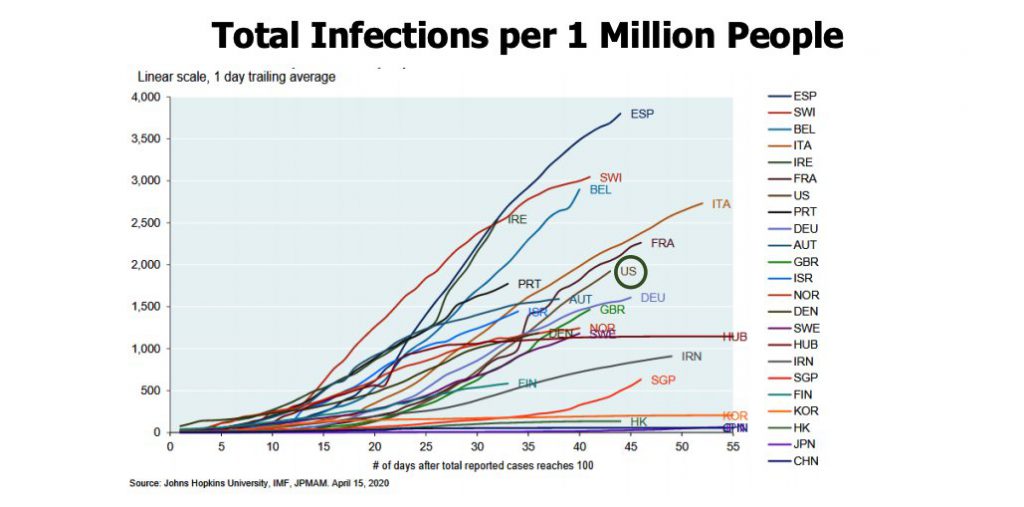
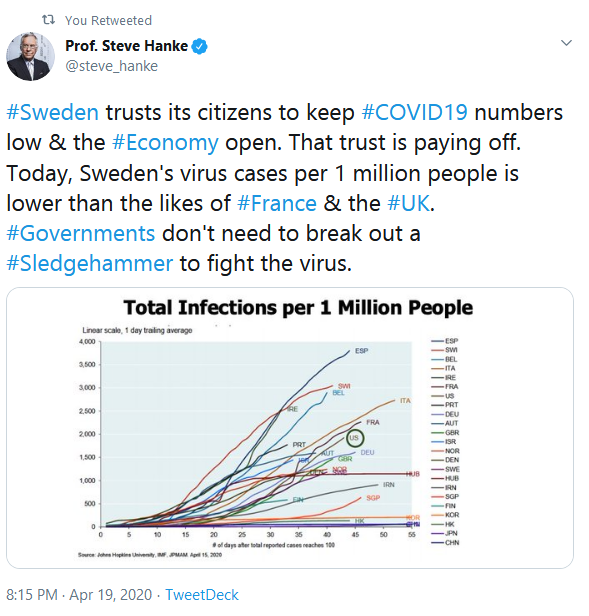
#Coronavirus: Total infections per 1 million people: Sweden does better than Germany

Still too early for a final judgment; but Sweden is an important alternative to the mainstream approach of total lockdown. Only this way we can learn how to best approach such pandemics to save lives in the future. Final answers only after we are “out of the fog”.

DEU: Germany; SWE: Sweden; GBR: UK; NOR: Norway; Source see below.

But Sweden currently has a much higher fatality ratio than Germany or other Nordic countries.

See for the diversity of academic views:

Source of figure: Twitter on April 20, 2020

Ends;

Posted in News, Policy | Comments Off on #Coronavirus: Total infections per 1 million people: Sweden does better than Germany

Why social distancing and lockdowns play an important role to fight the coronavirus: Interview with top medical historian Howard Markel of the University of Michigan.

The world still struggles about a convincing strategy to handle the #coronavirus crisis. What is the right strategy with social distancing. Were the huge lockdowns in many states necessary? How to move out of the lockdowns? Read the insights of one of the leading experts on epidemics world-wide.

Some core messages of the interview:

  • Our research showed that those cities that acted early in the big influenza epidemic of 1918, for long periods of time, and used several non-pharmaceutical interventions saw far lower rates of influenza cases and deaths compared to the cities that failed to take such measures or took them too late.
  • I do not believe letting the virus run wild to achieve herd immunity and leaving things wide open, as in Sweden, is a good idea.
  • In the fog of war it is always hard to gather good data.
  • We are all flying by the seat of our pants and making best guesstimates.
  • At least in the US, we are not there yet to terminate the widespread lockdowns.
  • I fear that CoVID-19 will be much worse than the influenza epidemic of 1918.

Howard Markel, M.D., Ph.D. is the George E. Wantz, M.D. Distinguished Professor of the History of Medicine and Director of the Center for the History of Medicine at the University of Michigan. He is also Professor of Pediatrics; Psychiatry; Public Health Management and Policy; History; and English Literature and Language.

He is the pre-eminent social and cultural historian of medicine, public health, and epidemics in the world. Author of 11 books and has contributed over 500 articles, reviews, essays and book chapters to a wide range of scholarly publications and popular periodicals. He has made hundreds of contributions for the media and is a prominent policy advisor.

More details about his expertise on epidemics below the interview. Full Bio.

Photo by Leisa Thompson

Interview

GLO: As a medical historian, you are one of the leading experts who have studied the big influenza epidemic of 1918: What can we learn from your research?
Markel H, Lipman HB, Navarro JA, et al. Nonpharmaceutical Interventions Implemented by US Cities During the 1918-1919 Influenza Pandemic. JAMA. 2007;298(6):644–654. doi:10.1001/jama.298.6.644

Howard Markel: In 2007, my colleagues and I at the University of Michigan Center for the History of Medicine and the U.S. Centers for Disease Control and Prevention studied the use of non-pharmaceutical interventions (NPIs) taken in the U.S. during the 1918-1919 influenza pandemic, which killed, at least, 40 million people around the globe and 500,000 to 750,000 Americans. We evaluated the public health efforts of 43 large cities that implemented some combination of commonly used NPIs:

1) isolating the ill or suspected cases in hospitals or at home;
2) banning public gatherings and in some cases, shutting down roads and railways; and
3) closing schools.

What we discovered was quite remarkable. Many cities acted early, meaning they pulled the levers to shut the gates of their city before the virus reached what is called an inflection point and spread widely causing hundreds if not more cases per day. We estimated that rate to be twice the normally expected number of cases of influenza in that city at that time, based on the previous year’s statistics.

Those cities that acted early, for long periods of time, and used more than one NPIs saw far lower rates of influenza cases and deaths compared to the cities that failed to take such measures or took them too late —after the virus had a chance to spread through the community.

GLO: Social distancing as a concept is applied to some extent in most countries, but was the complete lockdown of societies and economies really necessary? Why are e.g. the policies applied in South Korea and Sweden wrong?

Howard Markel: Early action is the key, of course, because these measures do not cure or prevent the spread of a virus. They only buy time, so that hospitals are not overrun with sick people and, perhaps, modern medicine can manufacture effective anti-viral drugs, treatments, or a vaccine. And because these measures are extremely disruptive to society, they should be employed only as a last resort and only for highly lethal and easily transmissible infections. When is meant by the phrase “last resort,” is that all other measures leading up to such socially disruptive NPIs do not seem to work elsewhere and we are dealing with an epidemics that has an especially high case fatality rate (number of deaths divided by total number of cases).

In 1918, the case fatality rate (CFR) was 2.5% (and in some countries such as India, over 10%), which is staggering compared to seasonal flu case fatality rates of about 0.1%. The 1918 pandemic that merited the most draconian of measures and it is important to note, they had no other tools to use, no antibiotics or antivirals, no vaccines, not even IV fluids. Right now, we are estimating relatively high CFR’s for CoVID-19, but are unsure of the precise number because while deaths are easy to quantify, the total number of cases is unclear—especially those with mild cases that do not see their doctor. We need better testing to be sure but given how sick CoVID-19 makes people and the number of deaths we are seeing, I believe it is better to be safe than sorry.

I do not believe letting the virus run wild to achieve herd immunity and leaving things wide open, as in Sweden, is a good idea given how many people with co-morbid diseases are at risk to get very sick and die. In 2020, there are many people living with cancer, AIDS, heart disease and other serious illnesses who would never be alive in 1918. These people are at serious risk of dying of CoVID-19 herd immunity, meaning 90% or more of a community is immune to a virus to prevent further spread of an epidemic disease, is best achieved by universal vaccination.

And a huge problem with CoVID-19 is that we have never experienced an epidemic with this particular virus and we do not yet have a stable case fatality rate to make good judgments. Hence, the policies we do develop are likely to be influenced by the adage, better safe than sorry. As such, we should not grouse about calls made “too early,” in the cause of fighting what may be a deadly epidemic.

GLO: Now we are in the middle of the fog, and it is difficult to know when to move back to some normal. Why are the statistics we have to rely on world-wide of so low quality?

Howard Markel: Precisely because we are in the fog of war and it is always hard to gather good data on the epidemic disease in question.

GLO: How long does it take to see the effects of public measures in the statistics?

Howard Markel: We should have better data in the coming weeks, late in the epidemic curve of each city, state or province, and country. But we are all flying by the seat of our pants and making best guesstimates based on a great deal of epidemiological data, modeling data and clinical information.

GLO: What could be the statistical indicator to decide on the termination of the widespread lockdowns?

Howard Markel: That’s the million dollar question. We don’t have a precise time to do this even though we know it needs to be late in the epidemic curve, not when cases are doubling every day, but instead are only popping up on a much more slow basis. We also need far more test kits to be able to contact trace the new cases and implement quarantine and isolation procedures for them. Simply put, at least in the US, we’re not there yet.

GLO: Why is New York the center of the epidemic in the US?

Howard Markel: Well, it’s the largest city in the world; it was late to implement social distancing measures, compared to other American cities and states; people live in crowded conditions—especially the poor—and then there is the mass transit system where people travel cheek by jowl on subways. These are just a few speculations but it has been sad to see how seriously my beloved New York City has been affected.

GLO: Moving outside of your territory as a historian, what do you speculate: Will we consider in some decades the coronavirus comparable to the influenza epidemic of 1918?

Howard Markel: To be honest, I fear it will be much worse. Let me put it this way, it will certainly keep historians of epidemics busy for many, many years!

GLO: Thank you very much for these insights!

*************
With Howard Markel spoke Klaus F. Zimmermann, GLO President on April 18, 2020. Both have been Rockefeller Foundation Bellagio Fellows in 2017.
Further activities and reports of the GLO Research Cluster on the coronavirus.

Review of epidemics-related work of Howard Markel

Dr. Markel is the author, co-author, or co-editor of eleven books including the award-winning Quarantine!  East European Jewish Immigrants and the New York City Epidemics of 1892 (Johns Hopkins University Press, 1997; paperback, Johns Hopkins University Press, 1999) and When Germs Travel: Six Major Epidemics That Have Invaded America Since 1900 and the Fears They Have Unleashed (Pantheon Books/Alfred A. Knopf, 2004; paperback Vintage/Random House, 2005).

From 2005 to 2006, Professor Markel served as a historical consultant on pandemic influenza preparedness planning for the United States Department of Defense.  From 2006 to 2015, he served as the principal historical consultant on pandemic preparedness for the Division of Global Migration and Quarantine of the U.S. Centers for Disease Control and Prevention.  From late April 2009 to February 2011, he served as a member of the CDC Director’s “Novel A/H1N1 Influenza Team B”, a real-time think tank of experts charged with evaluating the federal government’s and President Barack Obama’s influenza policies on a daily basis during and after the outbreak.  His historical research has played a pivotal role in developing the evidence base for many community mitigation strategies employed by the World Health Organization, the CDC, the Mexican Ministry of Health, and numerous state, provincial and municipal health departments around the globe during the 2009 influenza pandemic.

In collaboration with colleagues at the University of Michigan and the U.S. Centers for Disease Control and Prevention, Dr. Markel is Co-Editor-in-Chief of The 1918-1919 American Influenza Pandemic: A Digital Encyclopedia and Archive, which was first published in 2012 by the University of Michigan Center for the History of Medicine and the University of Michigan Scholarly Publications Office.  Funded by grants and contracts from the CDC, the Robert Wood Johnson Foundation, and the National Endowment for the Humanities, the digital encyclopedia represents one of the largest collections of historical documents ever assembled on a single epidemic and is accessible on the Internet at: www.influenzaarchive.org. The second edition of the 1918-1919 Influenza Pandemic: A Digital Encyclopedia and Archive 2.0 was released in 2016 and a third edition is now in preparation. 

During the Ebola epidemic of 2014, he was a much sought-after expert on the history of epidemics and quarantines.  Aside from wide press coverage, in the form of interviews, and his contributing several influential op-eds for the New Republic and Reuters Opinion, Professor Markel was the lead interview on NPR’s All Things Considered, BBC World Service, CNN/Sanjay Gupta MD, and PBS NewsHour. Dr. Markel’s landmark scholarship on the tangled history of stigma, politics and contagion was also lauded on the front page of The New Yorker, (Talk of the Town/Comment, November 10, 2014). In the aftermath of the Ebola crisis, in February of 2015, the Presidential (Barack Obama) Commission on Bioethical Issues invited him to consult on the ethical issues surrounding the stigma of epidemic and infectious diseases.

More recently, Dr. Markel played a prominent role in evaluating public health and social distancing policies as they played out in China and around the world during the CoVID-19, or coronavirus, epidemic of 2019-2020.  His pioneering 2007-2009 research on the use of community mitigation strategies for influence pandemics was the driving and life-saving force behind the entire global policy to CoVID-19.

On March 11, 2020, Nicholas Kristof, the eminent columnist for the New York Times cited Dr. Markel and his research team’s work as one of the “12 Steps to Tackle the Coronavirus.”  On April 1, 2020, he was the subject of a New Yorker magazine profile, “A Medical Historian on Why We Must Stay the Course in Fighting the Coronavirus.” At the National Academy of Medicine CoVid-19 briefing on March 25, 2020, he was “widely credited with coining the term flattening the curve.”  On April 6, 2020, Google honored the concept of “flattening the curve,” which he helped coin and scientifically demonstrate, by making it the first in a series of @GoogleDoodles for CoVid-19, on its masthead, dedicated “to public health workers and to researchers in the scientific community” during the crisis.  On April 16, in response to those wanting a lifting of the state’s CoVid-19 lockdown, Governor Gretchen Whitmer cited Dr. Markel’s non-pharmaceutical intervention research as the evidence base for her social distancing policies for the State of Michigan.

Markel’s two prominently run “Op-Ed” essays on the Chinese quarantine and containment strategies in Wuhan ran back-to-back in the Washington Post (January 26, 2020) and the New York Times (January 27, 2020) and were translated into multiple languages overseas, for the Chinese, Spanish, Portuguese, Russian, and Polish press. He discussed the impact of modern technology and connectivity on pandemics in an opinion essay for WIRED on March 4, 2020.  A highly influential Op-Ed essay on the importance of early school closures as a community mitigation strategy for CoVid-19 appeared online in the New York Times on March 6, 2020 and in print on March 9, 2020. Within a few days of its publication, school districts across the nation shut their doors. He also wrote important op-eds on the use of face masks, for NBC Think (April 3, 2020) and lessons from the 1918 influenza pandemic for The Washington Post (April 8, 2020). Professor Markel was also extensively interviewed about CoVID-19 for hundreds of stories and updates.

Research also of interest in this context:

J Alexander Navarro, Katrin Kohl, Martin Cetron & Howard Markel
A Tale of Many Cities: A Contemporary Historical Study of the Implementation of School Closures during the 2009 pA(H1N1) Influenza Pandemic
Journal of Health Politics, Policy and Law, Vol. 41, No. 3, June 2016, 393-421.
DOI 10.1215/03616878-3523958

Brian M. Davis, Howard Markel, Alex Navarro, Eden Wells, Arnold S. Monto & Allison E. Aiello
The Effect of Reactive School Closure on Community Influenza-Like Illness Counts in the State of Michigan During the 2009 H1N1 Pandemic
Clinical Infectious Diseases, Vol. 60, Issue 12, 15 June 2015, Pages e90–e97. DOI.org/10.1093/cid/civ182

Ends;

Posted in Interview, News | Comments Off on Why social distancing and lockdowns play an important role to fight the coronavirus: Interview with top medical historian Howard Markel of the University of Michigan.

#Conoravirus impact on developing countries will be much worse.

The world still struggles about a convincing strategy to handle the #coronavirus crisis. The developed world was affected first, but the forthcoming consequences for the developing countries may be much worse. Some insights from an interview with development economist Asad Islam of Monash University, Australia.

Some core messages of the interview:

  • The impact of COVID-19 is likely to be more severe in developing countries than in developed countries.
  • A temporary lockdown makes it possible to alert people that this is a serious health issue and everybody needs to protect themselves as much as possible.
  • Most developing countries have the capacity to provide three meals a day for its poorest population.
  • Developing countries need to allow their people to leave the lockdown earlier.
  • Our proposal for India suggested a broad-based transfer system, targeting more on poor people and increase the global fiscal stimulus substantially.
  • The pandemic is of more serious concern than initially thought.
  • Issues previously considered to be local ones are now recognized to be of global relevance and have to be addressed by global collaborations.

GLO Fellow Asad Islam is a Professor at the Department of Economics, and Director of the Centre for Development Economics and Sustainability (CDES) at the Faculty of Business and Economics at Monash University, Australia.

Interview

GLO: What is different with COVID-19 in a developing country than in a developed country?

Asad Islam: In developing countries, we see poorer health infrastructure such as a severe lack of hospital beds, intensive care units are not equipped with proper facilities for COVID-19 patients, missing trained nurses and doctors, lack of awareness among masses of people. Thus, the impact of COVID-19 is likely to be more severe in developing countries than in developed countries.

GLO: Is there no alternative to a complete lockdown of society and economy?

Asad Islam: The temporary lockdown in a developing country is a necessary evil to raise awareness about COVID-19. Social distancing won’t work without it. People have now almost stopped going to temple, mosque, church or social gatherings. This won’t happen without a lockdown! Lockdown needs to be temporary with gradual withdrawal (because of concerns for the poor) while making sure that the people try to maintain social distance (1.5 meter), and wear masks. A temporary lockdown makes it possible to alert people that this is a serious health issue and everybody needs to protect themselves as much as possible.

GLO: But unlike in developed countries, it seems very difficult for the government to financially support people. How can they survive?

Asad Islam: Most developing countries have the capacity to provide safety nets (e.g., providing three meals a day) for its poorest segments of the population. The problem is not lack of resources, but absence of mechanisms to reach the food to these poor people. The food distribution system could be made fairer even within this short period of time and most poor people can be brought under a direct transfer system. Of course, the pressure on the government is huge for maintaining this over a longer period. However, supporting its needy 30-40 percent of the population for 3-6 months using a public food distribution system is not an impossible job. International organizations such as the World Bank and the Asian Development Bank can also play a supportive role in ensuring this, particularly in countries where we see a serious lack of resources.

GLO: Lockdowns need to end at some time and one needs good statistics. What to do?

Asad Islam: We need to flatten the curve in developing countries, which means one needs to wait when the number of cases is rising rapidly. While the developed country can wait till there is no new case, in developing countries that would be very hard to achieve considering the economic hardship of poor people. One option is to allow the people to start working (for temporary period) who test negative, and younger people (age 20-50) if they do not have any major pre-existing condition.

GLO: With some colleagues you have recently proposed a strategy for India (see for a media report and the full memorandum). What is the message?

Asad Islam: Our main point was to have a broad-based transfer system, targeting more on poor people to enable them to cope with hardship during the lockdown, and increase the fiscal stimulus in manifold to address the economic woes of people.

GLO: Have economists underestimated the dangers of this pandemic?

Asad Islam: I think there were not enough data to begin with, and as it now stands both the number of infection cases and deaths were not reported accurately. As economists rely mostly on numbers there was more support for herd immunity in the beginning as the death rate was very low. However, as more accurate data are coming and we observe higher rate of deaths/infections we have now started to realize that the pandemic is of more serious concern on both health and economic grounds than initially thought.

GLO: How will the coronavirus change development economics?

Asad Islam: The world should now realize more that there are many issues we should not ignore, issues which sometimes we perceive to be the problem of a country or region only. Many problems including poverty and climate change need to be tackled globally and developed countries have more obligations to address them. The global public health issue will remain a serious concern in the coming years, and the problems of developing countries need to be better understood to address these challenges.

*************
With Asad Islam spoke Klaus F. Zimmermann, GLO President on April 18, 2020.
Further activities and reports of the GLO Research Cluster on the coronavirus.

Ends;

Posted in Interview, News | Comments Off on #Conoravirus impact on developing countries will be much worse.

Self-employed workers commute less than their employee counterparts.

A new GLO Discussion Paper finds that male and female self-employed workers in Western Europe devote 14% and 20% less time to commuting than their employee counterparts.

The Global Labor Organization (GLO) is an independent, non-partisan and non-governmental organization that functions as an international network and virtual platform to stimulate global research, debate and collaboration.

GLO Discussion Paper No. 514, 2020

Commuting and self-employment in Western Europe Download PDF
by
Giménez-Nadal, José Ignacio & Molina, José Alberto & Velilla, Jorge

GLO Fellow José Alberto Molina

Author Abstract: This paper explores the commuting behavior of workers in Western European countries, with a focus on the differences in commuting time between employees and the self-employed in these countries. Using data from the last wave of the European Working Conditions Survey (2015), we analyze the commuting behavior of workers, finding that male and female self-employed workers devote 14% and 20% less time to commuting than their employee counterparts, respectively. Furthermore, differences in commuting time between employees and self-employed females depend on the degree of urbanization of the worker’s residential location, as the difference in commuting time between the two groups of female workers is greater in rural areas, in comparison to workers living in urban areas. By analyzing differences in commuting time between groups of European workers, our analysis may serve to guide future planning programs.

Manhattan, New York, United States, NYC Subway
Photo by Manuel Lardizabal on Unsplash

GLO Discussion Papers are research and policy papers of the GLO Network which are widely circulated to encourage discussion. Provided in cooperation with EconStor, a service of the ZBW – Leibniz Information Centre for Economics, GLO Discussion Papers are among others listed in RePEc (see IDEAS,  EconPapers)Complete list of all GLO DPs – downloadable for free.

Ends;

Posted in News, Research | Comments Off on Self-employed workers commute less than their employee counterparts.