A new GLO Discussion Paper examines how work norms affect Social Security Disability Insurance (SSDI) take-up rates in response to worsening economic conditions focusing on immigrants in the US and their work norms determined in the home country. Receiving SSDI is more sensitive to economic downturns among immigrants from countries where people place less importance on work.
The Global Labor Organization (GLO) is an independent, non-partisan and non-governmental organization that functions as an international network and virtual platform to stimulate global research, debate and collaboration.
Author Abstract: We examine how work norms affect Social Security Disability Insurance (SSDI) take-up rates in response to worsening economic conditions. By focusing on immigrants in the US, we can consider the influence of work norms in a person’s home country, which we argue are exogenous to labor market prospects in the US. We find that the probability of receiving SSDI is more sensitive to economic downturns among immigrants from countries where people place less importance on work. We also provide evidence that this result is not driven by differential sensitivities to the business cycle or differences in SSDI eligibility.
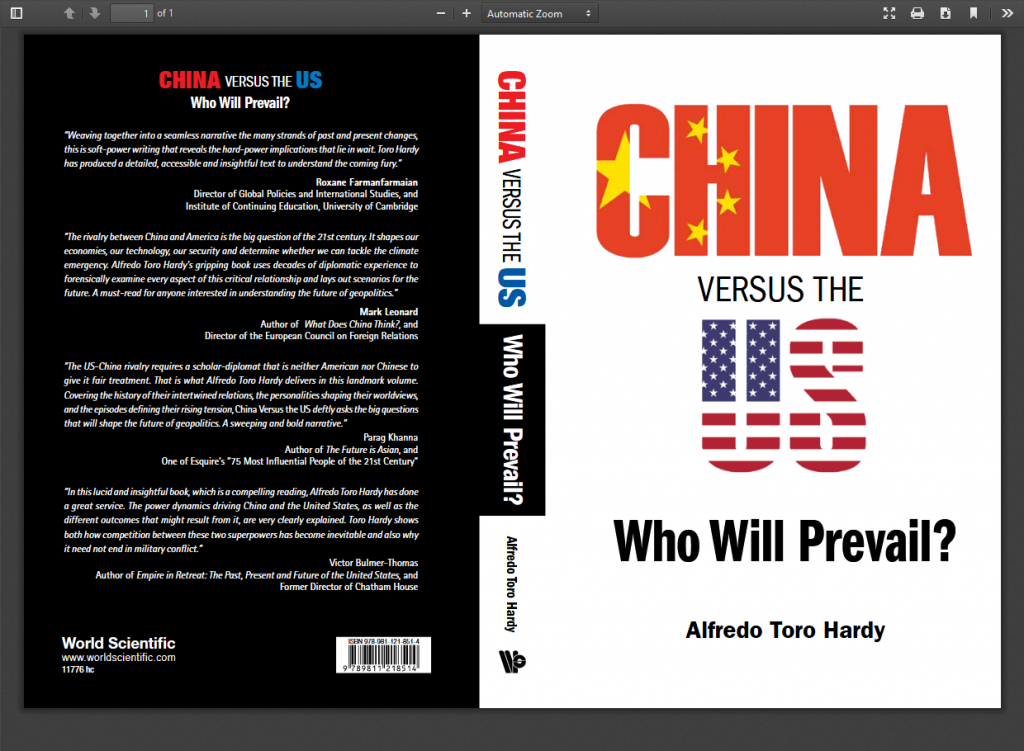
The rising rivalry between China and the US generates concerns around the world. In his new book (China versus the US. Who will prevail?), Alfredo Toro Hardy (Venezuelan Scholar and Diplomat) provides an insightful analysis of open questions and mysteries drawing from his life-long experience as a diplomat. In the interview below, he addresses some of the issues of concern.
New book! Alfredo Toro Hardy (Venezuelan Scholar and Diplomat): China versus the US. Who will prevail? 2020, World Scientific, 304 Pages. MORE INFORMATION.
Some core messages of the interview:
None will be ready to yield to the other.
The Chinese have made their aims more difficult to attain.
China would not accept to subordinate itself indefinitely to America’s leadership in its own part of the world.
Although the US possesses overall technological superiority, China will be able to match it or surpass it in a group of key technologies.
America’s democratic but utterly dysfunctional political system is being globally compared to China’s authoritarian but responsive one. There is no doubt that for many the latter results more attractive.
While globalization has allowed China to lift 800 million people out of poverty, nationalism identifies itself with the belief that the country’s ancient history and its tradition of centrality entitles it to a position of privilege.
Technological human displacement is not privative to China.
The confrontation between China and the US has become structural and not simply conjectural.
GLO Fellow Alfredo Toro Hardy, Venezuelan Scholar and Diplomat, is a former Ambassador of the Bolivarian Republic of Venezuela to the US, UK, Spain, Brazil, Chile, Ireland and Singapore.
Interview
GLO: Why has US-China competition become inevitable?
Alfredo Toro Hardy: Both countries perceive themselves as pinnacles within human history. The Middle Kingdom and the Exceptional Nation feel entitled to leadership by history or providence. Both look at the future under the lenses of their national myths. Under those circumstances none will be ready to yield to the other. Specially so as the gap in their comprehensive national power is rapidly closing.
GLO:Was China challenging the US too early?
Alfredo Toro Hardy: There seems to be no doubt that by speeding times, heralding their ambitions and boasting about their capabilities, while at the same time hardening their geopolitical and military stance, the Chinese have made their aims more difficult to attain. They have created for themselves many unnecessary problems. However, for a county as obsessed as China in continuously measuring its comprehensive national power, it would seem to be out of context to have provoked U.S. reaction if they have felt unprepared for a measurement of forces.
GLO: The obvious US response would be a long-term containment policy of China. How could this work?
Alfredo Toro Hardy: A long-term containment of China by the United States, would be the latter’s preferred option. Specially so, given the final success of this policy in relation to the Soviet Union. However, there is a big difference in both cases. During the Cold War, neither the Americans nor the Soviets challenged each other’s main spheres of influence (Cuba excepted, and this almost led to war). The contrast with the current situation is notorious. The United States’ containment of China not only includes Taiwan (which China considers to be an integral part of its territory) but takes place in an area that for millennia was a tributary dependent region of China. China would not accept to subordinate itself indefinitely to America’s leadership in its own part of the world.
GLO:You seem to suggest that China has the better cards to win the competition for world leadership, why?
Alfredo Toro Hardy: Although the United States still prevails in military, economic and technological capabilities, reverse trend in motion favor China. Economically, China’s ascendancy and its surpassing of the US seems inevitable. Militarily, China’s asymmetric power has the capacity to neutralize much of the current US superiority, while the inversely evolving budgetary capability of both countries will clearly play in favor of China. Moreover, America’s superiority in nuclear weapons may prove to be more theoretical than real if China’s overwhelming advantage in conventional ballistic missiles can match the US tactical nuclear capability, while China’s second-strike capacity can deter an American first strike. Finally, although the US possesses overall technological superiority, China will be able to match it or surpass it in a group of key technologies. On the other hand, China’s emphasis on strategically oriented basic research outweighs America’s market oriented applied research.
GLO:Globalism is under thread anyway. There is a global tendency to strengthen nationalism and autocratic regimes. A good time to popularize the Chinese model?
Alfredo Toro Hardy: Contrary to the Cold War with the USSR, America’s emerging Cold War with China is not based in ideology but in the efficiency that both countries’ models can exhibit. If we measure such efficiency by the handling of the Covid 19 pandemic, a clear difference emerges. Although the initial lack of transparency by China had a great impact in the global diffusion of the Coronavirus (and this certainly plays against its model), the extraordinary efficiency shown by this country in the domestic containment of the virus grossly contrasts with the botched response by the United States. America’s democratic but utterly dysfunctional political system is being globally compared to China’s authoritarian but responsive one. There is no doubt that for many the latter results more attractive.
GLO:In the Chinese understanding, there is complementarity of nationalism and globalization. What is the explanation?
Alfredo Toro Hardy: Chinese culture includes the complementary of opposites as exemplified by the duality of yin and yang. Within that context, globalization (so far synonymous of economic prosperity) and nationalism are seen as interdependent expressions of state policy, which converge in the aim of legitimizing the regime in the eyes of its citizens. While globalization has allowed China to lift 800 million people out of poverty, nationalism identifies itself with the belief that the country’s ancient history and its tradition of centrality entitles it to a position of privilege. Moreover, a century of humiliation by foreign powers impose the need to stand tall. This dual policy has been conceptualized under the aphorism of “grabbing with the two hands”. However, keeping the equilibrium between these forces is a daunting task. One false step, one overreach, one overreaction and everything might be blown to pieces.
GLO:Unlike the US, China’s future is burdened with its demographic problems (ageing, immigration pressure) and the need to achieve welfare increases through international trade, e.g. by importing necessary food. Is this not a challenge for the Chinese ambitions?
Alfredo Toro Hardy: With a rapidly aging population, as a result of the combination of low fertility rate and rising life expectancy, technology becomes a providential answer to the country’s quest to attain its “rejuvenation” –a nationalistic catchword that glues together the Chinese Communist Party and the Chinese population. Technology and rejuvenation thus become inseparable notions. Under those circumstances the search of economic prosperity and nationalism, the two strongest legitimizing forces of the regime, blend in their support to technology. However, even if technology “rejuvenate” the country it also displaces human labor and can significantly affect the welfare of many segments of society. Technological human displacement, though, is not privative to China. On the contrary, it is in the process of becoming one of the world’s biggest challenges of the Twenty First century. For the US, with a much larger percent of relay population and a lack of unifying national banners, this may lead to a more complex situation than China’s.
GLO:What role can the results of the forthcoming US Presidential elections play for the next phase of the US-China competition?
Alfredo Toro Hardy: I am afraid that a change in the White House may not change much. The confrontation between China and the US has become structural and not simply conjectural. Xi Jinping pursues fenfa youwei, meaning the attainment of great aims. This translates into a position of leadership in world affairs and a redefinition of its geopolitical footprint in Asia. For the United States this represents an unacceptable challenge to its leadership. In the same manner in which an expansive Chinese nationalism upholds Xi’s aims, a wide domestic coalition and an anti China popular sentiment sustain America’s reaction to that country’s assertiveness. Under those circumstances, Trump’s departure from the White House would only bring down Washington’s circus show, but not the emerging Cold War.
************* With Alfredo Toro Hardy spoke Klaus F. Zimmermann, GLO President.
Posted inNew Book, News, Policy|Comments Off on Alfredo Toro Hardy: “China versus the US. Who will prevail?” A new book explains why the rising confrontation between China and the US has become structural and not simply conjectural.
A new GLO Discussion Paper suggests that temporary migration policies may have beneficial impacts on immigrants’ sleep in the short-term.
The Global Labor Organization (GLO) is an independent, non-partisan and non-governmental organization that functions as an international network and virtual platform to stimulate global research, debate and collaboration.
Author Abstract: Stress is associated with sleep problems. And poor sleep is linked with mental health and depression symptoms. The stress associated with immigrant status and immigration policy can directly affect mental health. While previous studies have documented a significant relationship between immigration policy and the physical and mental health of immigrants, we know little about the effects that immigration policy may have on immigrants’ sleep patterns. Exploiting the approval of the Deferred Action for Childhood Arrivals (DACA) in 2012, we study how immigrants’ sleep behavior responds to a change in immigration policy. Consistent with previous research documenting positive effects of DACA on mental health, we find evidence of a significant improvement in immigrants’ sleep in response to this policy change. However, the estimated effects of the policy quickly disappear since 2016. While temporary authorization programs, such as DACA, may have beneficial impacts on immigrants’ sleep in the short-term, the effects of temporary programs can be rapidly undermined by the uncertainty on their future. Thus, permanent legalization programs may be more effective in achieving long-term effects, eliminating any uncertainty related to the undocumented immigrant legal status.
A new GLO Discussion Paper using large-scale firm data for Denmark finds that government aid was effective in preserving job matches at the start of the Covid-19 pandemic.
The Global Labor Organization (GLO) is an independent, non-partisan and non-governmental organization that functions as an international network and virtual platform to stimulate global research, debate and collaboration.
Author Abstract: We analyze the impact of the COVID-19 pandemic and government policies on firms’ aid takeup, layoff and furlough decisions. We collect new survey data for 10,642 small, medium and large Danish firms, and match to government records of all aid-supported furloughed workers during the pandemic as well as administrative accounting data. This is the first representative sample of firms reporting the pandemic’s impact on their revenue and labor choices, showing a steep decline in revenue and a strong reported effect of labor aid take-up on lower job separations. Relative to a normal year, 30 percent more firms have experienced revenue declines. Comparing firms’ actual layoff and furlough decisions to their reported counterfactual decisions in the absence of aid, we estimate 81,000 fewer workers were laid off and 285,000 workers were furloughed. Our results suggest the aid policy was effective in preserving job matches at the start of the pandemic.
TheGLO Virtual Seminar is a monthly internal GLO research event chaired by GLO Director Matloob Piracha hosted by the GLO partner institution University of Kent. The results are posted on the GLO website and the GLO News section, where also the Video of the presentation is posted. All GLO related videos are also available in the GLO YouTube channel. (To subscribe go there.)
Announcement: August 6, 2020; London/UKat 1-2 pm — Sergei Guriev, Sciences Po, Paris, and GLO The Political Economy of Populism Registration details will be provided in time.
A new GLO Discussion Paper finds that the inclusion of family workers more than triples the free female labor force participation rate in the 1860 Census of the USA, from 16 percent to 56 percent, which is comparable to today’s rate (57 percent in 2018).
The Global Labor Organization (GLO) is an independent, non-partisan and non-governmental organization that functions as an international network and virtual platform to stimulate global research, debate and collaboration.
Author Abstract: Rates of labor force participation in the US in the second half of the nineteenth century among free women were exceedingly (and implausibly) low, about 11 percent. This is due, in part, to social perceptions of working women, cultural and societal expectations of female’s role, and lack of accurate or thorough enumeration by Census officials. This paper develops an augmented free female labor force participation rate for 1860. It is calculated by identifying free women (age 16 and older) who were likely providing informal and unenumerated labor for market production in support of a family business, that is, unreported family workers. These individuals are identified as not having a reported occupation, but are likely to be working on the basis of the self-employment occupation of other relatives in their households. Family workers are classified into three categories: farm, merchant, and craft. The inclusion of this category of workers more than triples the free female labor force participation rate in the 1860 Census, from 16 percent to 56 percent, which is comparable to today’s rate (57 percent in 2018).
A new GLO Discussion Paper suggests that following the EU Referendum Results on Brexit Non-EU migrants experienced an improvement in both mental health and life satisfaction relative to the UK natives.
The Global Labor Organization (GLO) is an independent, non-partisan and non-governmental organization that functions as an international network and virtual platform to stimulate global research, debate and collaboration.
Author Abstract: This paper is the first attempt to analyze the effect of the Brexit Referendum results on subjective well-being of immigrants living in the UK. Using the national representative UK Household Longitudinal Study (Understanding Society) data and adopting a difference-in-differences estimates, we define natives as control group, and different sub-groups of immigrants as treatment groups. The current analysis suggests that following the EU Referendum Results Non-EU migrants experienced an improvement in both mental health and life satisfaction relative to the UK natives. The results are robust to several robustness checks. Among others, we account for unobserved individual fixed effects and for unbalanced panel data. The results are consistent with the idea that the end of free movement for EU immigrants has alleviated the sense of discrimination and frustration felt by Non-EU immigrants results mainly of the toughened visa restrictions enforced since 2010 by the UK Government.
A new GLO Discussion Paper finds that Covid-19 has induced a decline in business ownership in Canada.
The Global Labor Organization (GLO) is an independent, non-partisan and non-governmental organization that functions as an international network and virtual platform to stimulate global research, debate and collaboration.
Author Abstract: Using the Canadian Labour Force Survey, we document the short-term impact of COVID-19 on self-employed individuals in Canada, which we interpret as small business owners. We document an important decrease in business ownership between February 2020 and May 2020 (-14.8 percent for incorporated and -10.1 percent for unincorporated entities). We find a greater decrease in ownership and aggregate hours for women, immigrants and less educated over the same period. The industries with the largest decrease are in art, culture, and recreation (-14.8 percent); in education, law and social, community and government services (-13.6 percent); and in sales and service occupations (-12.8 percent).
School of Public Health, Peking Union Medical College
Meinian Public Health Research Institute, Peking University Health Science Center
Geocomputation Center for Social Sciences, Wuhan University
School of Public Health, Huazhong University of Science and Technology
School of Medicine and Health Management, Huazhong University of Science and Technology
School of Public Health, Central South University
School of Public Health, Guangxi Medical University
School of Health Policy and Management, Nanjing Medical University
School of Health Care Management, Shandong University
School of Public Policy and Administration, Xi’an Jiaotong University
School of Public Health, Southern Medical University
School of Public Health, Guizhou Medical University
School of Public Health, Guangdong Pharmaceutical University
Institute of Health Education and Lifecourse Promotion (iHELP)
9:00-11:00 PM, July 9, 2020
I. Overview (in Chinese)
An Overview of Models for COVID-19 Pandemic, Perter Song, University Michigan
An Overview of Data and Resources for COVID-19 Modeling, Tao Hu, Harvard University
Discussants:
Qiushi Chen, Penn State University
Chaowei Yang, George Mason University
Chair: Harry Zhang, Old Dominion University
9:00-11:00 PM, July 16, 2020
II. Methodology (in Chinese)
Peng Gong, Tsinghua University
Jian Ni, Johns Hopkins University
Discussants:
Shiyong Liu, Southwest University of Finance and Economics
Mingwang Shen, Xian Jiaotong University
Chair: Jian Wang, Wuhan University
9:00-11:00 PM, July 23, 2020
III.Applications (in English)
Xi Chen, Yale University
Winnie Chi-Man Yip, Harvard University
Discussants:
Yiwei Chen, Stanford University
Liming Cai, U.S. Centers for Medicare & Medicaid Services
Chair: Mengxi Zhang, Ball State University
9:00-11:00 PM, July 30, 2020
IV. Predictions, Role of Intervention and the Historic National Lockdown in India(in English)
Bhramar Mukherjee, Debashree Ray, Maxwell Salvatore, Rupam Bhttacharyya, University of Michigan
Discussant:
Yanfang Su, University of Washington
Chair: Lizheng Shi, Tulane University
Background:
As a joint effort by scholars and professionals from the Center for Geographical Analysis at Harvard University, the Geo-Computation Center for Social Sciences at Wuhan University, the China Data Institute, the Spatiotemporal Innovation Center at George Mason University, RMDS Lab, and some other institutions, an initiative on “Resources for COVID-19 Study” was sponsored by the China Data Lab project (http://chinadatalab.net). The objectives of this project are: (1) to provide data support for the spatial study of COVID-19 at local, regional and global levels with information collected and integrated from different sources; (2) to facilitate quantitative research on spatial spreading and impacts of COVID-19 with advanced methodology and technology; (3) to promote collaborative research on the spatial study of COVID-19 on the China Data Lab, Dataverse and WorldMap platforms; and (4) to build research capacity for future collaborative projects. This forum will discuss data resources, methodology, technology, and applications for COVID-19 models across countries and regions.
Posted inNews, Research, Teaching|Comments Off on Modeling COVID-19 Pandemic: Resources, Methodology, and Applications. A series of webinars (July 9-30, 2020).
A new GLO Discussion Paper finds that Covid-19 lockdowns have affected happiness across countries (South Africa, New Zealand, and Australia) strongly: The more stringent stay-at-home regulations are, the greater the negative effect.
The Global Labor Organization (GLO) is an independent, non-partisan and non-governmental organization that functions as an international network and virtual platform to stimulate global research, debate and collaboration.
Author Abstract: Since the start of the Covid-19 pandemic, many governments have implemented lockdown regulations to curb the spread of the virus. Though lockdowns do minimise the physical damage of the virus, there may be substantial damage to population well-being. Using a pooled dataset, this paper analyses the causal effect of mandatory lockdown on happiness in three very diverse countries (South Africa, New Zealand, and Australia), regarding population size, economic development and well-being levels. Additionally, each country differs in terms of lockdown regulations and duration. The main idea is to determine, notwithstanding the characteristics of a country or the lockdown regulations, whether a lockdown negatively affects happiness. Secondly, we compare the effect size of the lockdown on happiness between these countries. We make use of Difference-in-Difference estimations to determine the causal effect of the lockdown and Least Squares Dummy Variable estimations to study the heterogeneity in the effect size of the lockdown by country. Our results show that, regardless of the characteristics of the country, or the type or duration of the lockdown regulations; a lockdown causes a decline in happiness. Furthermore, the negative effect differs between countries, seeming that the more stringent the stay-at-home regulations are, the greater the negative effect.