A new GLO Discussion Paperreviews the economic literature on social remittances.
The Global Labor Organization (GLO) is an independent, non-partisan and non-governmental organization that functions as an international network and virtual platform to stimulate global research, debate and collaboration.
Author Abstract: This article reviews the economic literature on social remittances. Unlike financial remittances, which are flows of cash or goods sent by migrants to their origin countries, social remittances refer to economic, social, political attitudes, behaviours and norms that are transmitted through migration. Although economists are newcomers to this literature, they have contributed to advancing knowledge on the causal effects of migration on social remittances. The evidence reviewed in this article unanimously points at the important role played by international migration in the transfer of norms. However, host countries matter greatly in explaining the types of attitudes and knowledge that are transferred back to countries of origin. Overall, there are still clear gaps in our understanding of social remittances that future research would need to address to enable us to appreciate better the mechanisms through which norms are transferred.
A new GLO Discussion Paperpredicts that in the presence of natural resources and rent seeking, ethnic diversity increases concentration of political power, reduces income per capita and increases income inequality.
The Global Labor Organization (GLO) is an independent, non-partisan and non-governmental organization that functions as an international network and virtual platform to stimulate global research, debate and collaboration.
Author Abstract: The empirical evidence suggests that the resource rich countries tend to have poor economic performance and higher rent seeking. In this paper, we develop a general equilibrium model explaining why natural resources turn out to be a curse in an economy divided into two classes: elite and workers. Our model explains the resource curse in a setup in which governing elite expropriate rents from natural resources which reduces the productive use of these resources. The expected costs and benefits of such rent seeking activities depend on the degree of ethnic polarization which affects the concentration of political power, and on the quality of institutions which constraints rent seeking. The model predicts that in the presence of natural resources and rent seeking, ethnic diversity increases concentration of political power, reduces income per capita and increases income inequality. Moreover, the impact will be higher in economies that depend more on natural resources.
EBES and GLO are partner organizations. GLO President Klaus F. Zimmermann is also President of EBES.
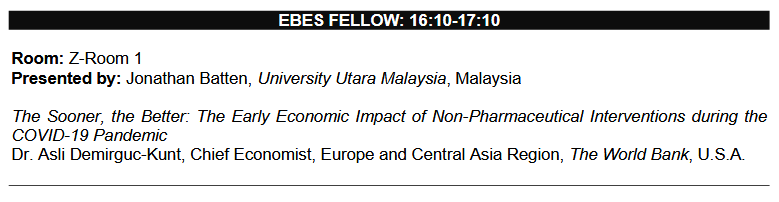
Among the highlights are the sessions below with GLO Fellows Mehmet Huseyin Bilgin, Jonathan Batten, Marco Vivarelli and Dorothea Schäfer.
Asli Demirguc-Kunt will speak on the occasion of her appointment as EBES Fellow 2020.
Dr. Asli Demirguc-Kunt is the Chief Economist of Europe and Central Asia Region of the World Bank. Over her 30-year career in the World Bank, she has also served as the Director of Research, Director of Development Policy, and the Chief Economist of the Finance and Private Sector Development Network, conducting research and advising on financial and private sector development issues. She has published articles in many of the leading economics and finance journals such as Journal of Finance, Journal of Financial Economics, Journal of Financial and Quantitative Analysis, The Review of Financial Studies, Journal of Banking and Finance, Journal of Monetary Economics, Journal of Money, Credit and Banking, Journal of Economic Perspectives etc. and is among the most-cited researchers in the world (Google Scholar = 76K). Her research has focused on the links between financial development, firm performance, and economic development. Banking and financial crises, financial regulation, access to financial services and inclusion, as well as SME finance and entrepreneurship are among her areas of research. She has also created the Global Financial Development Report series and the Global Findex financial inclusion database. She was the President of the International Atlantic Economic Society (2013-14) and Director of the Western Economic Association (2015-18) and serves on the editorial boards of professional journals. Prior to her position in the World Bank, she was an Economist at the Federal Reserve Bank of Cleveland. She holds a Ph.D. and M.A. in economics from Ohio State University.
A new GLO Discussion Paperadvertises for the unemployment-to-population ratio and the inactivity-to-population ratio as two highly appropriate and complementary measures of labor market health.
The Global Labor Organization (GLO) is an independent, non-partisan and non-governmental organization that functions as an international network and virtual platform to stimulate global research, debate and collaboration.
Author Abstract: This article introduces the metaphor of the iceberg in the labor market. While policy in most OECD countries has historically focused on reducing unemployment (the tip of the iceberg), the group of inactive people (below the waterline) is much larger. Therefore, we point to the clear limitations of the unemployment rate as the (single) key macro-economic indicator of the health of the labor market. A parsimonious dashboard approach utilizing the unemployment-to-population ratio and the inactivity-to-population ratio as two highly appropriate and complementary measures is defended. We show that the ratio of these two indices varies greatly between countries, which calls for different policies for different countries.
Report of the Editor-in-Chief 2020 (23 July, 2020) PDF of Report
The Journal of Population of Economicsis an international quarterly that publishes original theoretical and applied research in all areas of population economics, household economics, and human resources. This report contains information about the Journal and its editorial process in the past year and some earlier years.
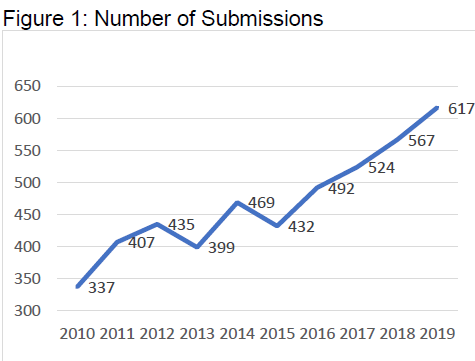
The number of submissions has substantially increased over recent years (Figure 1). Between 2011 and 2013, the Journal received about 400 submissions per year; by 2016 the number of submissions neared 500, and in 2019, 617 manuscripts were received. The inflow appears to be holding steady; as of the end of July 2020, the journal had received 485 new manuscripts; during the same period last year, a much smaller number of manuscripts (327) had been received.
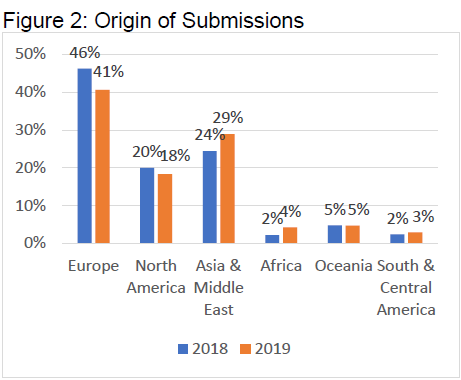
In line with past years, the largest single share of submissions made in 2019 were from corresponding authors based in Europe (Figure 2). Over 40% of all submissions originated from Europe, and nearly one-third (29%) of submissions came from authors based in Asia and the Middle East. Under one-fifth (20%) of submissions came from authors based in North America. The remaining submissions came from contributors from Africa (4%), Oceania (Australia and New Zealand; 5%), and South and Central America (3%).
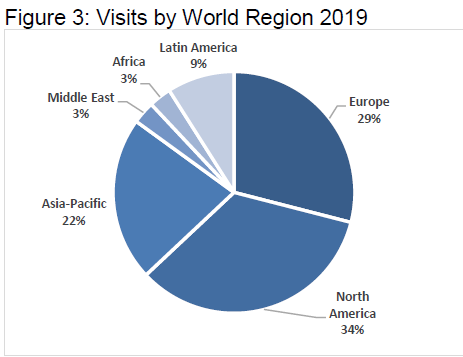
Figure 3 contains the internet visits to the Journal on the Springer website from the world regions. With over a third of visits coming from North America and 29% from Europe, followed by the Asia-pacific region (22%), the Journal is globally accessed and read.
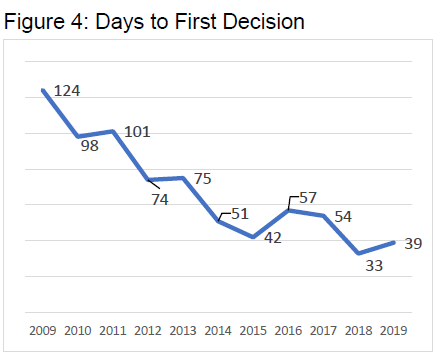
Figure 4 shows that the average number of days between submission and first decision has generally declined over time. Despite a slight uptick in the turnaround time for first decisions between 2015 and 2016, which may be partially attributed to the increased volume of submissions, there was a substantial reduction in turnaround time in following years. In 2019, the average time for first decisions was 30 days. The Journal is committed to keep the time between submission and decisions low, including eventual publication. Since 2013 the Journal has executed a desk rejection policy to provide authors with an early signal for better targeting of their work. The large number of submissions combined with an annual quota of 40 manuscripts keeps the acceptance rates of the Journal very low.
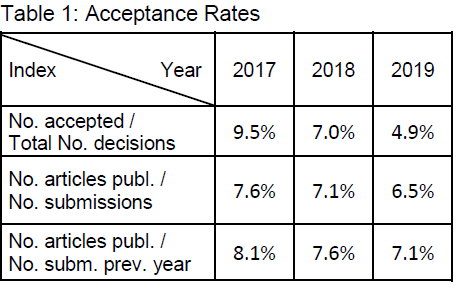
Table 1 shows three acceptance rate measures: 1) the number of manuscripts accepted in a given year as a share of all final decisions made in that year; 2) the number of published articles in a given year as a share of all submissions in that year; and; 3) the number of articles published in a given year divided by the number of the previous year’s submissions.
The number of accepted papers (submitted at any point in time) in a given year as a share of all decisions made in that year has shifted over time. Compared to 9.5% in 2017, the acceptance rate has declined from 7% in 2018 to 4.9% in 2019. If acceptance rate is measured as the number of published manuscripts as a share of total submissions received in that year, the acceptance rate was slightly higher, at 6.5% in 2019 (or 40 manuscripts from among 617 submissions), falling 7.6% in 2017 and 7.1% in 2018. Measuring the acceptance rate as the number of publications as a share of the number of submissions received in the previous year (2018) would yield a 2019 rate of 7.1%, which is lower than the previous years (8.1% in 2017 and 7.6% in 2018).
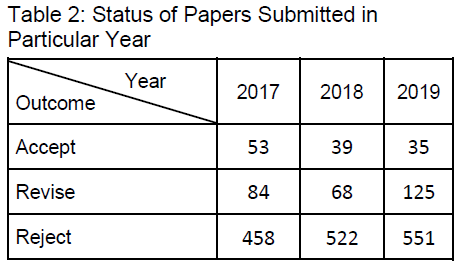
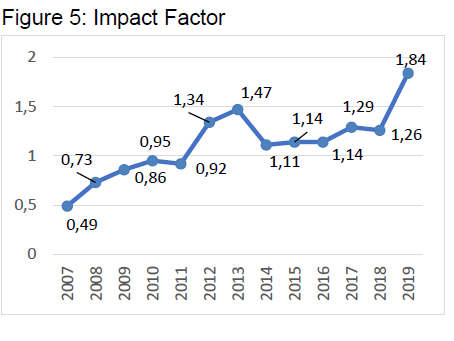
Table 2 reports the status of papers submitted in the given year for years 2017 – 2019. The Journal’s Impact Factor has increased substantially over time (Figure 5). In 2019, the just published simple Impact Factor was 1.840, and the 5-year Impact Factor was 2.353. The Journal ranked 120/371 in economics and 11/29 in demography in 2019. As of July 2020, the Journal’s IDEAS/RePEc ranking was 77/2,485 (based on the Simple Impact Factor 15.682, for Journals and all years).
The Journal is ranked in: Social Science Citation Index, Journal Citation Reports/Social Sciences, SCOPUS, EconLit, Google Scholar, EBSCO Discovery Service, ProQuest, CAB International, ABS Academic Journal Quality Guide, Academic OneFile, Academic Search, Bibliography of Asian Studies, CAB Abstracts, CSA Environmental Sciences, Current Contents/Social & Behavioral Sciences, ECONIS, ERIH PLUS, Gale, Global Health, International Bibliography of the Social Sciences (IBSS), JSTOR, OCLC, Research Papers in Economics (RePEc), Review of Population Reviews, SCImago, and Summon by ProQuest.
Klaus F. Zimmermann, Editor-in-Chief Journal of Population Economics
Posted inNews, Research|Comments Off on Journal of Population Economics: One third rise in submissions, highest impact factor ever, fast editorial decisions.
A new GLO Discussion Paper finds that the stay-at-home order led to a large decrease in traffic accidents as a large decrease in mobility in Louisiana. Further, the composition of accidents has changed.
The Global Labor Organization (GLO) is an independent, non-partisan and non-governmental organization that functions as an international network and virtual platform to stimulate global research, debate and collaboration.
Author Abstract: We use a regression discontinuity design to study the effect of the COVID-19 lockdown on mobility and traffic accidents. Based on data from Google Community Mobility reports and Uniform Traffic Crash Report from the Louisiana Department of Transportation and Development (LaDOTD), we find that the stay-at-home order led to a large decrease in traffic accidents (-47 percent). In particular, we find a large decrease in accidents involving injury (-46 percent), distracted drivers (-43 percent), and ambulances (-41 percent). We also find evidence of a change in the composition of accidents, with more incidents involving individuals aged 25 to 64, male, and nonwhite drivers. Interestingly, we find no impact on ambulance response time, despite lower traffic. Finally, we document a large decrease in mobility in Louisiana. Our results have important policy implications for traffic management policies.
A new GLO Discussion Paper finds that restrictions on migration causes unemployment while the effects of restrictions on trade are not so clear.
The Global Labor Organization (GLO) is an independent, non-partisan and non-governmental organization that functions as an international network and virtual platform to stimulate global research, debate and collaboration.
Author Abstract: To combat COVID-19 the entire world has resorted to global lockdown implying restriction on international labor migration and trade. This paper aims to check the effect of such restrictions on the unemployment of unskilled labor in the source country. In competitive general equilibrium framework with three goods and four factors restriction on migration raises unemployment for given factor intensity. The results remain same even in a slightly different structure of the economy. In case of trade restriction, however, the rise or fall in unemployment depends on both the structure of the economy and the factor intensity assumption.
A new GLO Discussion Paper suggests that in Greece during the COVID-19 period job separations were lower than usual but employment declined due to a dramatic slowdown in hiring.
The Global Labor Organization (GLO) is an independent, non-partisan and non-governmental organization that functions as an international network and virtual platform to stimulate global research, debate and collaboration.
Author Abstract: We use administrative, survey, and online vacancy data to analyze the short-term labor market impacts of the COVID-19 lockdown in Greece. We find that flows into unemployment have not increased; in fact, separations were lower than would have been expected given trends in recent years. At the same time, employment was about 12 percent lower at the end of June than it would have been without the pandemic. Our interrupted time series and difference-in-differences estimates indicate that this was due to a dramatic slowdown in hiring during months when job creation typically peaks in normal years, mostly in tourism. While we do not formally test the reasons for these patterns, our analysis suggests that the measures introduced to mitigate the effects of the crisis in Greece have played an important role. These measures prohibited layoffs in industries affected by the crisis and tied the major form of income support to the maintenance of employment relationships.
A new paper published in the Journal of Population Economics finds that immigration indeed decreases far-right votes in Finland and provides an explanation.
OPEN ACCESS – Published Online. Forthcoming in print version: Journal of Population Economics (2021), volume 34.
Author Abstract: Across Europe, far-right parties have made significant electoral gains in recent years. Their anti-immigration stance is considered one of the main factors behind their success. Using data from Finland, this paper studies the effect of immigration on voting for the far-right Finns Party on a local level. Exploiting a convenient setup for a shift-share instrument, I find that a 1 percentage point increase in the share of foreign citizens in a municipality decreases the Finns Party’s vote share by 3.4 percentage points. Placebo tests using pre-period data confirm this effect is not driven by persistent trends at the municipality level. The far-right votes lost to immigration are captured by the two pro-immigration parties. Turning to potential mechanisms, immigration is found to increase voter turnout, potentially activating local pro-immigration voters. Moreover, the negative effect is only present in municipalities with high initial exposure to immigrants, consistent with the intergroup contact theory. Finally, I also provide some evidence for the welfare-state channel as a plausible mechanism behind the main result.
A new GLO Discussion Paper suggests that COVID-19 may further accentuate the existing divide between globally competitive advanced producer services and more locally focused sectors providing lower-value personal and household services, posing a number of significant policy challenges for London.
The Global Labor Organization (GLO) is an independent, non-partisan and non-governmental organization that functions as an international network and virtual platform to stimulate global research, debate and collaboration.
Author Abstract: Over the last 50 years, London has successfully adapted to technological change and globalization, making it the major driver of the UK economy. But its strengths have also made the city particularly vulnerable to the health impacts of COVID-19, and potentially also to wider negative economic implications of the crisis. Many of London’s key sectors rely on proximity, agglomeration economies and externalities. We evaluate the available data on the impact of the pandemic on London to date, with a particular focus on the differential effects between sectors. We also identify seven key trends, affecting both the demand and supply side of the economy, that are likely to have significant medium- to long-term economic impacts, and assess the potential impacts on London’s major industrial sectors. Our findings suggest that COVID-19 may further accentuate the existing divide between globally competitive advanced producer services and more locally focused sectors providing lower-value personal and household services, posing a number of significant policy challenges.
Posted inNews, Research|Comments Off on A Global City in a Global Pandemic: Assessing the Ongoing Impact of COVID Induced Trends on London’s Economic Sectors