TheGLO Virtual Seminar is a monthly internal GLO research event chaired by GLO Director Matloob Piracha and hosted by the GLO partner institution University of Kent. The results are available on the GLO website and the GLO News section, where also the video of the presentation is posted. All GLO related videos are also available in the GLO YouTube channel. (To subscribe go there.)
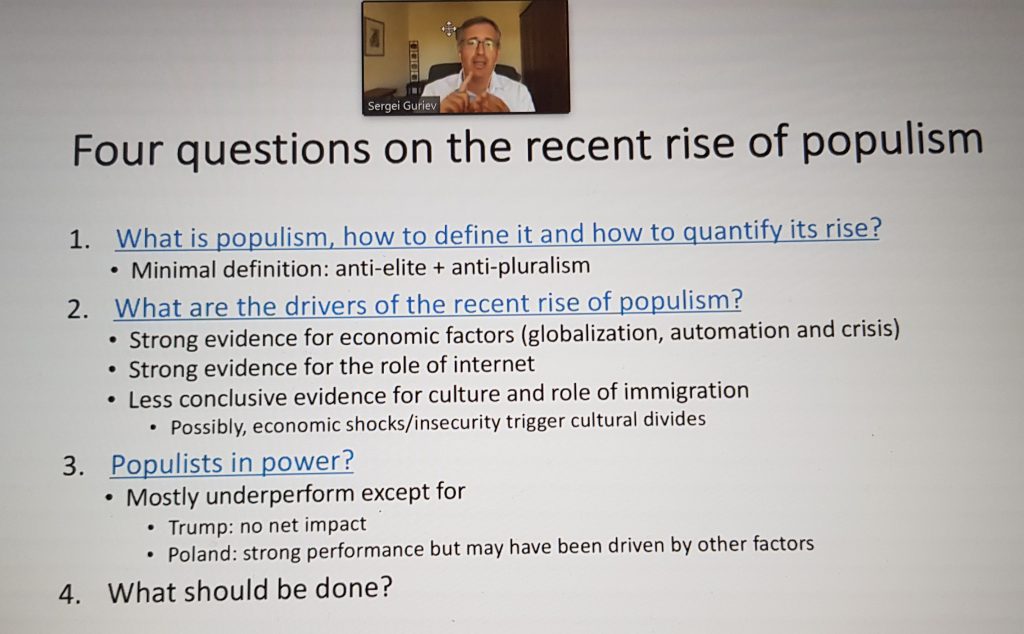
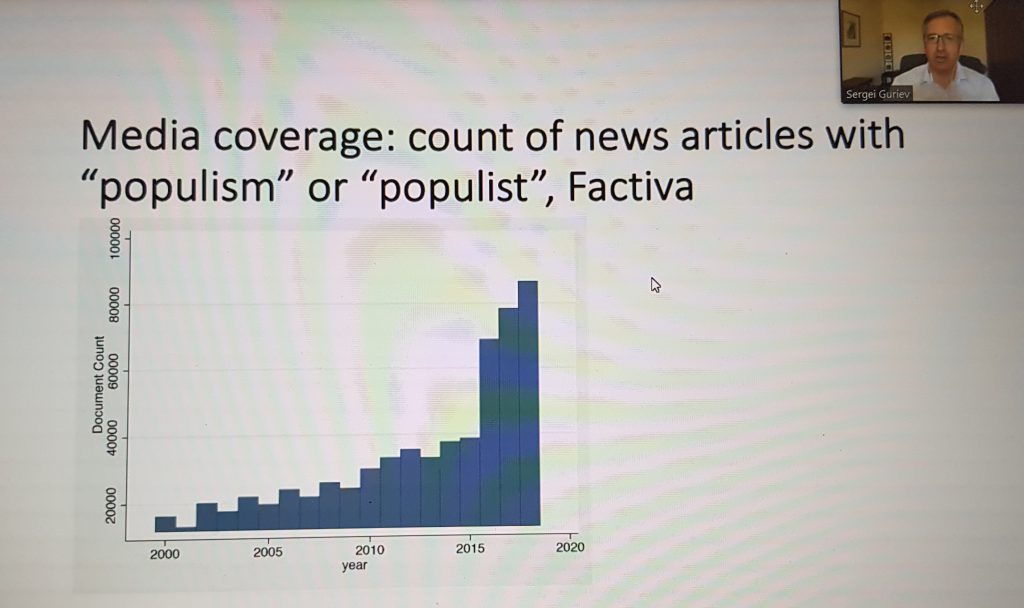
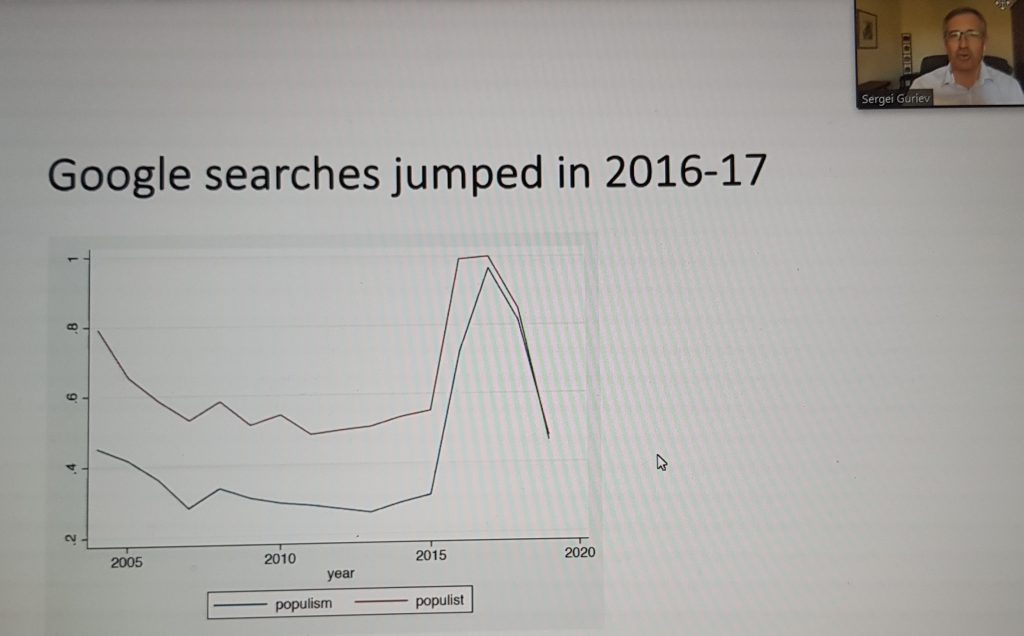
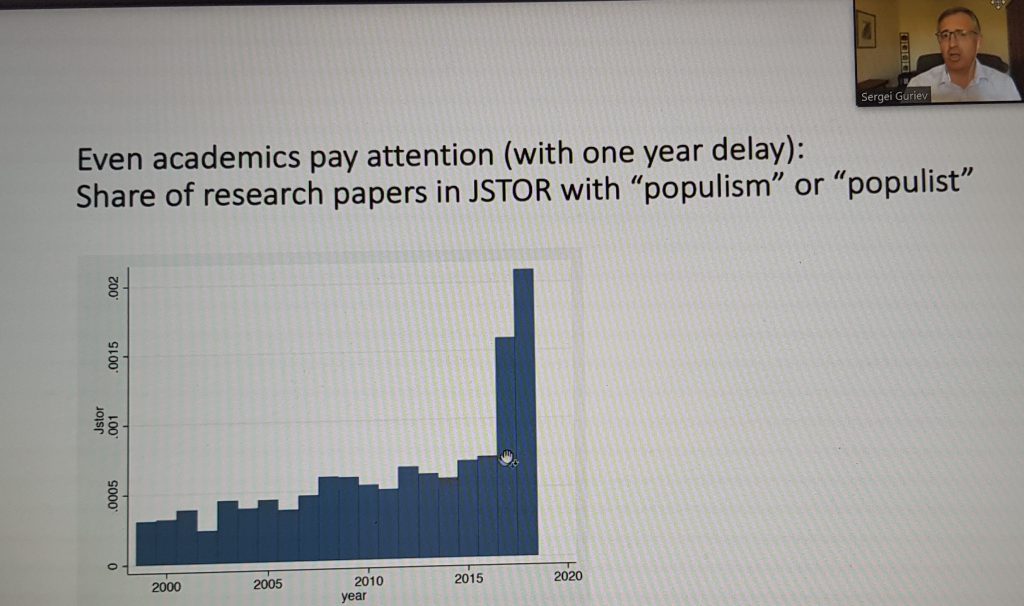
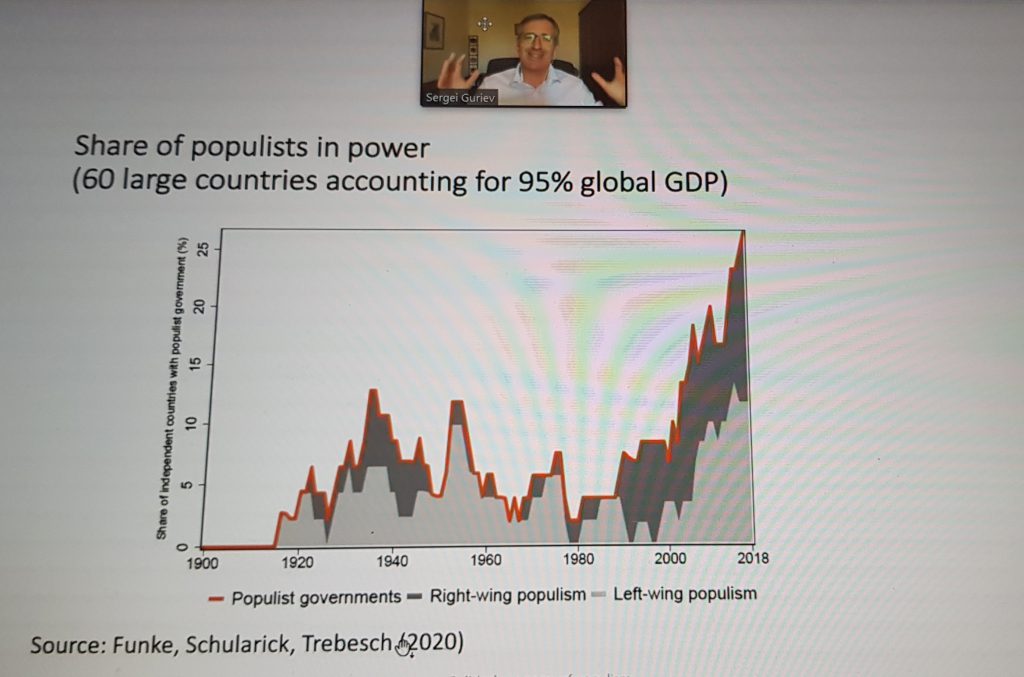
The last seminar was given by Sergei Guriev on The Political Economy of Populism. Below find a report, the video of the seminar and the background paper.
Announcement/forthcoming seminar: September 3, 2020:London/UKat 1-2 pm —Kompal Sinha, Macquarie University and GLO Topic: To be announced. Registration details will be provided in time.
GLO Director Matloob Piracha
Report
The Political Economy of Populism
GLO Virtual Seminar on August 6, 2020 with Sergei Guriev (Sciences Po & GLO). Video !!!
Related paper: Sergei Guriev and Elias Papaioannou, The Political Economy of Populism.PDF Draft prepared for the Journal of Economic Literature.
GLO President Klaus F. Zimmermann following the lecture of Sergei Guriev from his homeoffice.
A new GLO Discussion Paperstudies the Australian labor market for native and foreign students and finds that acquiring education in the host country does not appear to eliminate uneven labor market outcomes between natives and foreigners.
The Global Labor Organization (GLO) is an independent, non-partisan and non-governmental organization that functions as an international network and virtual platform to stimulate global research, debate and collaboration.
Author Abstract: This paper studies the labor market outcomes of native and foreign PhD graduates staying as migrants in Australia, using data on career destinations over the period 1999-2015. Natives with an English-speaking background emerge as benefiting from positive employer discrimination, especially if graduating in Science, Technology, Engineering and Mathematics (STEM), for which they receive a premium that is unrelated to observed characteristics such as gender, age, and previous work experience. In contrast, foreign PhD graduates with a non-English speaking background experience worse labor market outcomes, especially if they work in the university sector. Acquiring education in the host country does not appear to eliminate uneven labor market outcomes between natives and foreigners.
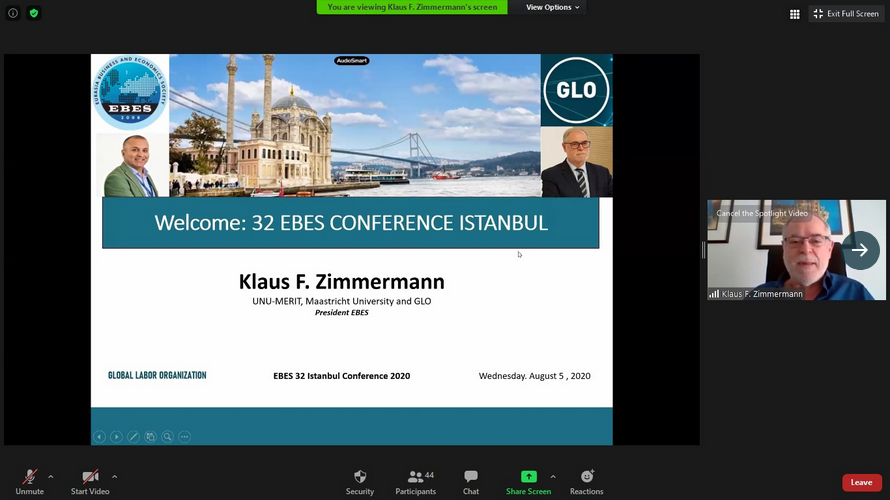
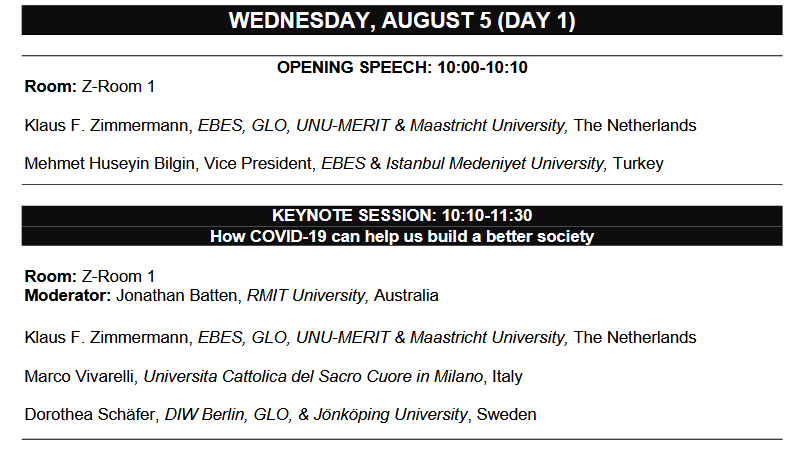
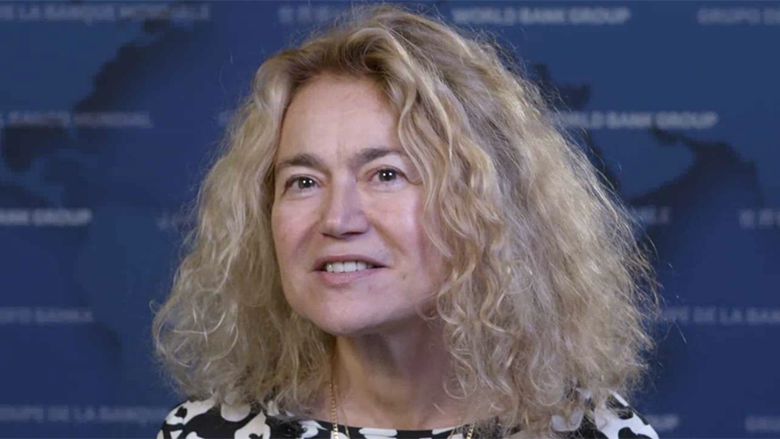
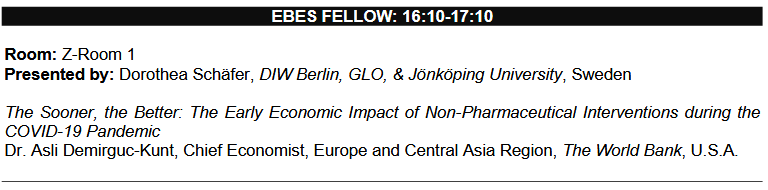
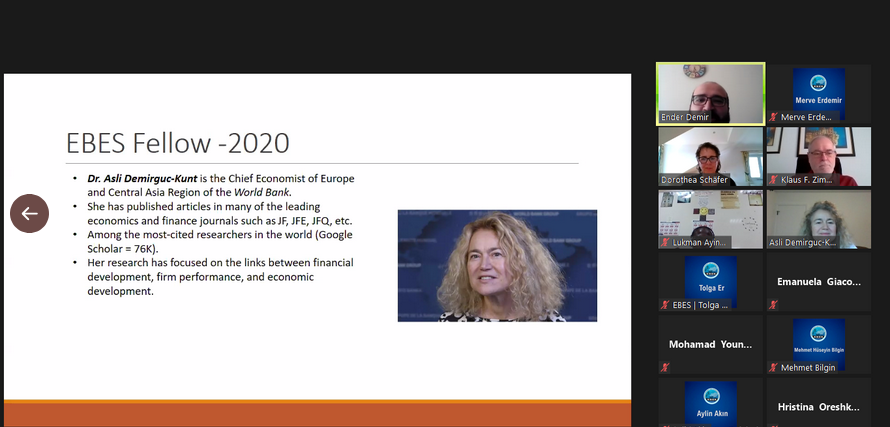
EBES and GLO are partner organizations. GLO President Klaus F. Zimmermann is also President of EBES. Among the highlights were the sessions below with GLO Fellows Mehmet Huseyin Bilgin, Jonathan Batten, Marco Vivarelli and Dorothea Schäfer. Asli Demirguc-Kunt (World Bank) spoke on the occasion of her appointment as EBES Fellow 2020. Klaus F. Zimmermann congratulated her to this honor and closed the appointment session.
From the left: Batten, Bilgin, Schäfer, Vivarelli, Zimmermann
In his opening speech, EBES President Klaus F. Zimmermann was using his recent joint paper in The World Economy with EBES colleagues to introduce the inter-country transmission challenge of the Covid-19 pandemic and outlined the consequences for academic networking and conferencing. He was calling for attempts to introduce social components into virtual conferences.
The Keynote Panel on How Covid-19 can help us build a better society?was chaired and guided by Jonathan Batten. Klaus F. Zimmermann spoke on human resources issues, Marco Vivarelli an the labor market and Dorothea Schäfer on financial markets.
****************************************** BACKGROUND PAPERmentioned by Zimmermann as an example in his panel contribution. UNU-MERIT Discussion Paper No. 2020-015 Taking the challenge: A joint European policy response to the corona crisis to strengthen the public sector and restart a more sustainable and social Europe by Jo Ritzen, Javi Lopez, André Knottnerus, Salvador Pérez-Moreno, George Papandreou & Klaus F. Zimmermann
• Strong & social Europe • Joint Euro area monetary funding • Joint Euro area borrowing conditional on strong commitments for sustainable development • Better public sector with joint taxation • Sound fiscal behavior • Full employment strategy with vocational training, retraining • Free internal mobility, open labor immigration policy; joint refugee policy. ********************************************
A new GLO Discussion Paperpresents a model which shows that wages, prices and real income should grow faster in countries with low increase in their labor force.
The Global Labor Organization (GLO) is an independent, non-partisan and non-governmental organization that functions as an international network and virtual platform to stimulate global research, debate and collaboration.
Author Abstract: We develop a model which shows that wages, prices and real income should grow faster in countries with low increase in their labor force. If not, other countries experience growing unemployment and/or trade deficit. This result is applied to the case of Germany, which has displayed a significantly lower increase in its labour force than its trade partners, except in the moment of the reunification. By assuming that goods are differentiated according to their country of origin (Armington’s hypothesis), a low growth of the working population constrains the production of German goods, which entails an increase in their prices and in German wages. This mechanism is magnified by the low price elasticity of the demand for German goods. Hence, the German policy of wage moderation could severely constrain other countries’ policy options. The simulations of an extended model which encompasses offshoring to emerging countries and labor market imperfections suggest that (i) the impact of differences in labor force growth upon unemployment in Eurozone countries has been significant and (ii) the German demographic shock following unification could explain a large part of the 1995-2005 German economic turmoil.
A new GLO Discussion Paperpresents a model where better-off individuals mate genetically close partners, and then use wealth to treat their children’s health problems.
The Global Labor Organization (GLO) is an independent, non-partisan and non-governmental organization that functions as an international network and virtual platform to stimulate global research, debate and collaboration.
Author Abstract: In this note, I address the trade-off between children’s health and parental preference toward similarity with children. In my model, better-off individuals mate genetically close partners and then use wealth to treat their children’s health problems, caused by inbreeding depression. As a result, the relationship between parental wealth and children’s health includes decreasing portions. Siblings health inequality is also nonmonotonically related to parental wealth, if parents discriminate in favor of more similar children.
A new GLO Discussion Paper finds that all caste groups lost jobs in the first month of the Covid-19 lockdown, the job losses for lowest-ranked caste are greater by factor of three.
The Global Labor Organization (GLO) is an independent, non-partisan and non-governmental organization that functions as an international network and virtual platform to stimulate global research, debate and collaboration.
Author Abstract: Using nationally representative panel data for 21,799 individuals between May 2018 and April 2020, this paper investigates whether the Covid-19 pandemic was indeed a “Great Leveler” in the sense that it imposed similar and equivalent labour market shocks on different caste groups. We find that while all caste groups lost jobs in the first month of the lockdown, the job losses for lowest-ranked caste are greater by factor of three. The data shows that the disproportionate effects stems from lower levels of human capital and over-representation in vulnerable jobs for the lowest ranked caste groups in the country.
A new GLO Discussion Paper using mortality data for Italy finds that the growth in total mortality rates can potentially be used as a statistically reliable predictor of mortality crises.
The Global Labor Organization (GLO) is an independent, non-partisan and non-governmental organization that functions as an international network and virtual platform to stimulate global research, debate and collaboration.
Author Abstract: The paper provides initial evidence that excess mortality rates by locality can be used as a statistically reliable predictor of looming mortality crises. Using recently published daily deaths figures for 7,357 Italian municipalities, we estimate the growth in daily mortality rates between the period 2015-2019 and 2020 by province. All provinces that experienced a major mortality shock in mid-March 2020 had increases in mortality rates of 100% or above already in mid-February 2020. This increase was particularly strong for males and older people, two recognizable features of COVID-19. Using panel data models, we find a strong positive and significant association between overall deaths and COVID-19 related deaths, and between early increases in mortality rates in February 2020 for any cause and the March 2020 outbreak in COVID-19 deaths. We conclude that the growth in mortality rates can potentially be used as a statistically reliable predictor of mortality crises, including COVID- 19 crises.
A new GLO Discussion Papersurveys the empirical literature to find that taste-based discriminationcanbetter explain ethnic discrimination in hiring than statistical discrimination.
The Global Labor Organization (GLO) is an independent, non-partisan and non-governmental organization that functions as an international network and virtual platform to stimulate global research, debate and collaboration.
Author Abstract: Scholars have gone to great lengths to chart the incidence of ethnic labour market discrimination. To effectively mitigate this discrimination, however, we need to understand its underlying mechanisms because different mechanisms lead to different counteracting measures. To this end, we reviewed the recent literature that confronts the seminal theories of taste-based and statistical discrimination against the empirical reality. First, we observed that the measurement operationalisation of the mechanisms varied greatly between studies, necessitating the development of a measurement standard. Second, we found that 20 out of 30 studies examining taste-based discrimination and 18 out of 34 studies assessing statistical discrimination produced supportive evidence for said mechanisms. However, (field) experimental research, which predominantly focuses on hiring outcomes, yielded more evidence in favour of taste-based vis-à-vis statistical discrimination, suggesting that the taste-based mechanism might better explain ethnic discrimination in hiring.
A new GLO Discussion Paperprovides anunderstanding of the mechanisms of hiring discrimination towards former burnout patients .
The Global Labor Organization (GLO) is an independent, non-partisan and non-governmental organization that functions as an international network and virtual platform to stimulate global research, debate and collaboration.
Author Abstract: Hiring discrimination towards (former) burnout patients has been extensively documented in the literature. To tackle this problem, it is important to understand the underlying mechanisms of such discrimination. Therefore, we conducted a vignette experiment with 425 genuine recruiters and jointly tested the potential stigma against job candidates with a history of burnout that were mentioned earlier in the literature. We found candidates revealing a history of burnout elicit perceptions of requiring work adaptations, likely having more unpleasant collaborations with others as well as diminished health, autonomy, ability to work under pressure, leadership capacity, manageability, and learning ability, when compared to candidates with a comparable gap in working history due to physical injury. Led by perceptions of a reduced ability to work under pressure, the tested perceptions jointly explained over 90% of the effect of revealing burnout on the probability of being invited to a job interview. In addition, the negative effect on interview probability of revealing burnout was stronger when the job vacancy required higher stress tolerance. In contrast, the negative impact of revealing burnout on interview probability appeared weaker when recruiters were women and when recruiters had previously had personal encounters with burnout.
A new GLO Discussion Paperfinds long-term evidence that the youngest cohort students participate less often in the Erasmus exchange program than older cohort members.
The Global Labor Organization (GLO) is an independent, non-partisan and non-governmental organization that functions as an international network and virtual platform to stimulate global research, debate and collaboration.
GLO Fellow Magnus Carlsson & GLO Affiliate Luca Fumarco
Luca Fumarco
Magnus Carlsson
Author Abstract: This study contributes to the literature on long-term effects of relative age (i.e. age differences between classmates in compulsory school) by examining tertiary education outcomes. We investigate whether there is evidence of relative age effects on university students enrolled in the Erasmus exchange program. We use administrative data on all exchange students who visited the Linnaeus University, in Sweden, in the four years since its founding. We find long-term evidence of RAEs—the youngest cohort students participate less often to the Erasmus exchange program than older cohort members.