
Bonn January 5, 2021. 2.15 pm.
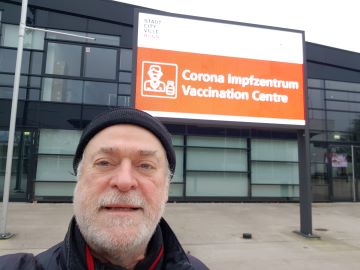
In front of the Vaccination Centre Bonn, which is part of the Bonn World Conference Center.
All closed. Alles zu….
Ends;
Bonn January 5, 2021. 2.15 pm.
In front of the Vaccination Centre Bonn, which is part of the Bonn World Conference Center.
All closed. Alles zu….
Ends;
A new GLO Discussion Paper finds that the successful lockdown in Vietnam kept mortality amazingly low, but had negative effects on unemployment, the temporary layoff rate, and the quality of employment. It also reduced workers’ numbers of working hours and their monthly incomes and wages.
The Global Labor Organization (GLO) is an independent, non-partisan and non-governmental organization that functions as an international network and virtual platform to stimulate global research, debate and collaboration.
GLO Discussion Paper No. 741, 2020
Did a Successful Fight against the COVID-19 pandemic Come at a Cost? Impacts of the Outbreak on Employment outcomes in Vietnam – Download PDF
by Dang, Hai-Anh H. & Nguyen, Cuong Viet
GLO Fellows Hai-Anh Dang & Cuong Nguyen


Author Abstract: Vietnam is widely praised for its successful fight against the COVID-19 pandemic. The country has had an extremely low mortality rate of 35 deaths to date (out of a population of approximately 100 million) and currently has no community transmission. We offer the first study that examines the effects of the COVID-19-induced lockdown on various employment outcomes for Vietnam. We employ difference-in-differences econometric models to estimate the causal effects of the lockdown, using rich individual-level data from the quarterly Labor Force Surveys. We find that the lockdown increases the unemployment rate, the temporary layoff rate, and decreases the quality of employment. It also reduces workers’ numbers of working hours and their monthly incomes and wages. Our estimation results remain robust to different model specifications and estimation samples. Further heterogeneity analysis suggests that the effects vary across education levels and occupation sectors but are similar across regions or provinces with different lockdown durations.
More from the GLO Coronavirus Cluster

GLO Discussion Papers are research and policy papers of the GLO Network which are widely circulated to encourage discussion. Provided in cooperation with EconStor, a service of the ZBW – Leibniz Information Centre for Economics, GLO Discussion Papers are among others listed in RePEc (see IDEAS, EconPapers). Complete list of all GLO DPs – downloadable for free.
Ends;
Reflected by the GLO Website glabor.org, 2020 has been another very active year of the network. This was based on the hard work of our activists on all levels and on the constructive support of our various partners around the globe.
Thanks to all GLO Fellows, Affiliates and partners! And the wider audience in the profession and the society for your interest!
While the coronavirus is a challenge to globalization, global collaboration is also the best response. Hence, we went on and started a number of initiatives for which the world has become more open and more flexible. Our experience is that the willingness to communicate and interact has increased.
Below I present a short overview on GLO’s major achievements in the past year 2020.
Klaus F. Zimmermann, GLO – President

GLO and CU-COLLAR at Chulalongkorn University in Thailand affiliate. December 27, 2020
IESR & GLO intensify strategic partnership May 18, 2020
The COVID-19 Pandemic and the 2020 U.S. Presidential Election. A new GLO Discussion Paper by GLO Fellow Abel Brodeur and Leonardo Baccini & Stephen Weymouth. Forthcoming in the Journal of Population Economics. November 12, 2020
Revealing the Sources of the Chinese Success Story in the Anti-Corona Fight, January-February 2020. Paper forthcoming in the Journal of Population Economics. April 9, 2020
Third Renmin University—GLO Conference on the Chinese Labor Market took place virtually on December 19, 2020. Video of the event now available. December 21, 2020
November 23, 2020 Vienna: “COVID-19” Virtual Workshop of the Academia Europaea (AE) Section “Economics, Business and Management Sciences” hosted by the Central European University (CEU). November 16, 2020
In Operation: IESR-GLO Joint Conference on COVID-19 with Daron Acemoglu, Charles Manski & 16 paper presenters. Second day today. Some pictures of yesterday. June 6, 2020
Full Program & Registration for Third IESR-GLO Joint Conference with Daron Acemoglu (MIT) and Charles Manski (Northwestern University) now available. June 1, 2020
Marie Claire Villeval teaches norms in the streets. Video from the GLO Virtual Seminar Series. July 10, 2020
Report & Video available: Journal of Population Economics Webinar on the Kuznets Prize 2021 ceremony & the presentation of the newly published Issue 1, 2021. January 1, 2021
Sandro Cigno celebrates 80th birthday & retires as Editor of the Journal of Population Economics. December 24, 2020
Journal of Population Economics: One third rise in submissions, highest impact factor ever, fast editorial decisions. July 29, 2020
Successful Kuznets Prize Ceremony with Nobel Prize Winner Jim Heckman at ASSA 2020 in San Diego. Impressions from the Reception. January 5, 2020
GLO Virtual Young Scholars Program (GLO VirtYS): Announcement of the 2020-21 GLO VirtYS Cohort. November 23, 2020
Third Webinar in the GLO Virtual Young Scholar (GLO-VirtYS) Program, Cohort 2019-20: Report and Video. October 16, 2020
Interview with GLO Fellow Ilhom Abdulloev on Tajikistan, one of the world’s most remittance-dependent countries. November 30, 2020
” I fear it will be much worse.” GLO Interview on the #coronavirus with Howard Markel, physician and medical historian at the University of Michigan, who has studied the use of non-pharmaceutical interventions in the big influenza epidemic of 1918 in the US. April 20, 2020
#Coronavirus and now? GLO – Interview with Top #Health Economist Xi Chen of Yale University. March 16, 2020
Ends;
Volume 34, issue 1, 2021 of the Journal of Population Economics is published. See below the list of articles and access links to read or download the contributions.
A Journal of Population Economics Online Workshop hosted by UNU-MERIT, Maastricht took place on November 19, 2020 (2-5 pm CET). The detailed agenda is below presenting highlights on “Covid-19” and “societal conflict” from the new issue.

Video of the event.
2.00 – 2.15 pm CET Maastricht
Welcome: Michaella Vanore (Managing Editor; UNU-MERIT & Maastricht University)
Journal of Population Economics: Report
Klaus F. Zimmermann (Editor-in-Chief; UNU-MERIT & Maastricht University)


2.15 – 2.45 pm CET Maastricht
Lead paper Issue 1/2021: Session Chair Terra McKinnish (Editor; University of Colorado Boulder)

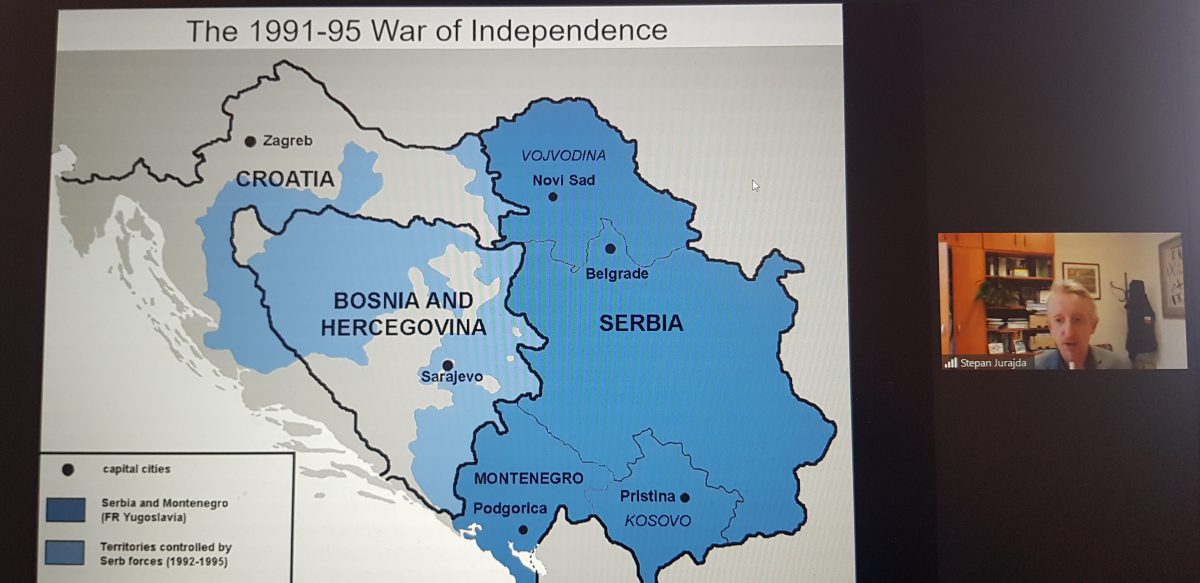
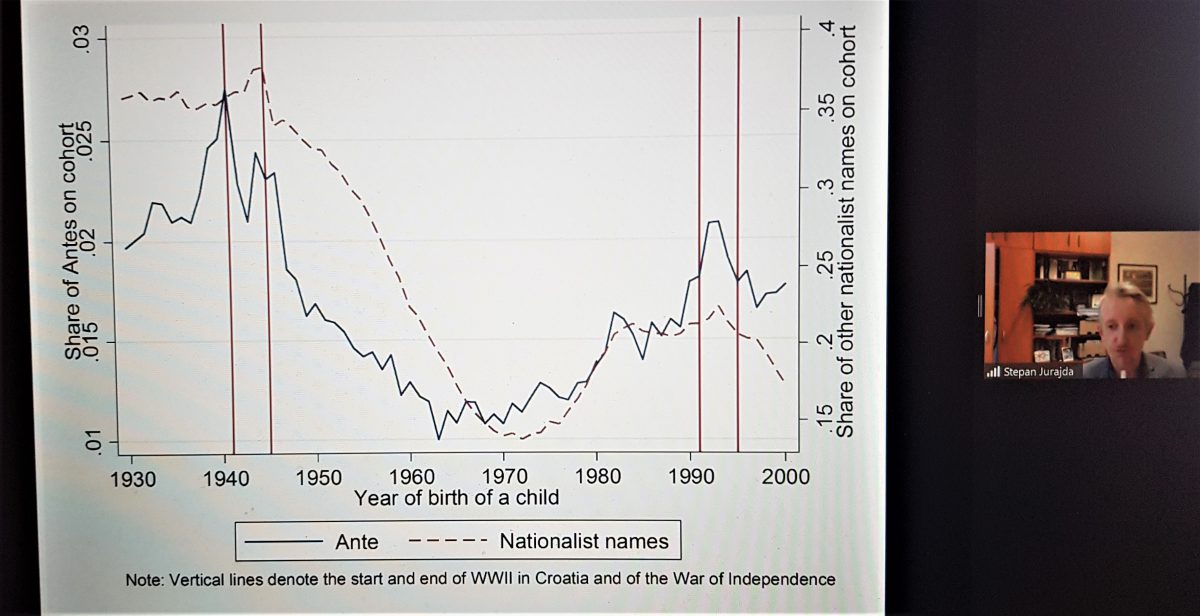
“Names and behavior in a war” presented by Štěpán Jurajda (CERGE-EI, Prague)
Co-author: Dejan Kovač (Princeton University and Zagreb)

Discussion





2.45 – 3.15 pm CET Maastricht
Kuznets Prize 2021:
“Impacts of social and economic factors on the transmission of coronavirus disease 2019 (COVID-19) in China”, published in the Journal of Population Economics (2020), 33(4), pp. 1127–1172. OPEN ACCESS.
Bartel Van de Walle (Director, UNU-MERIT) presented UNU-MERIT & delivered the prize laudation.

Panel with the authors chaired by Klaus F. Zimmermann (Editor-in-Chief; UNU-MERIT & Maastricht University): Yun Qiu (Jinan University), Xi Chen (Yale University), and Wei Shi (Jinan University)




From the left: Xi Chen, Wei Shi and Klaus F. Zimmermann





3.15 – 4.00 pm CET Maastricht
Panel: Publishing in Population Economics
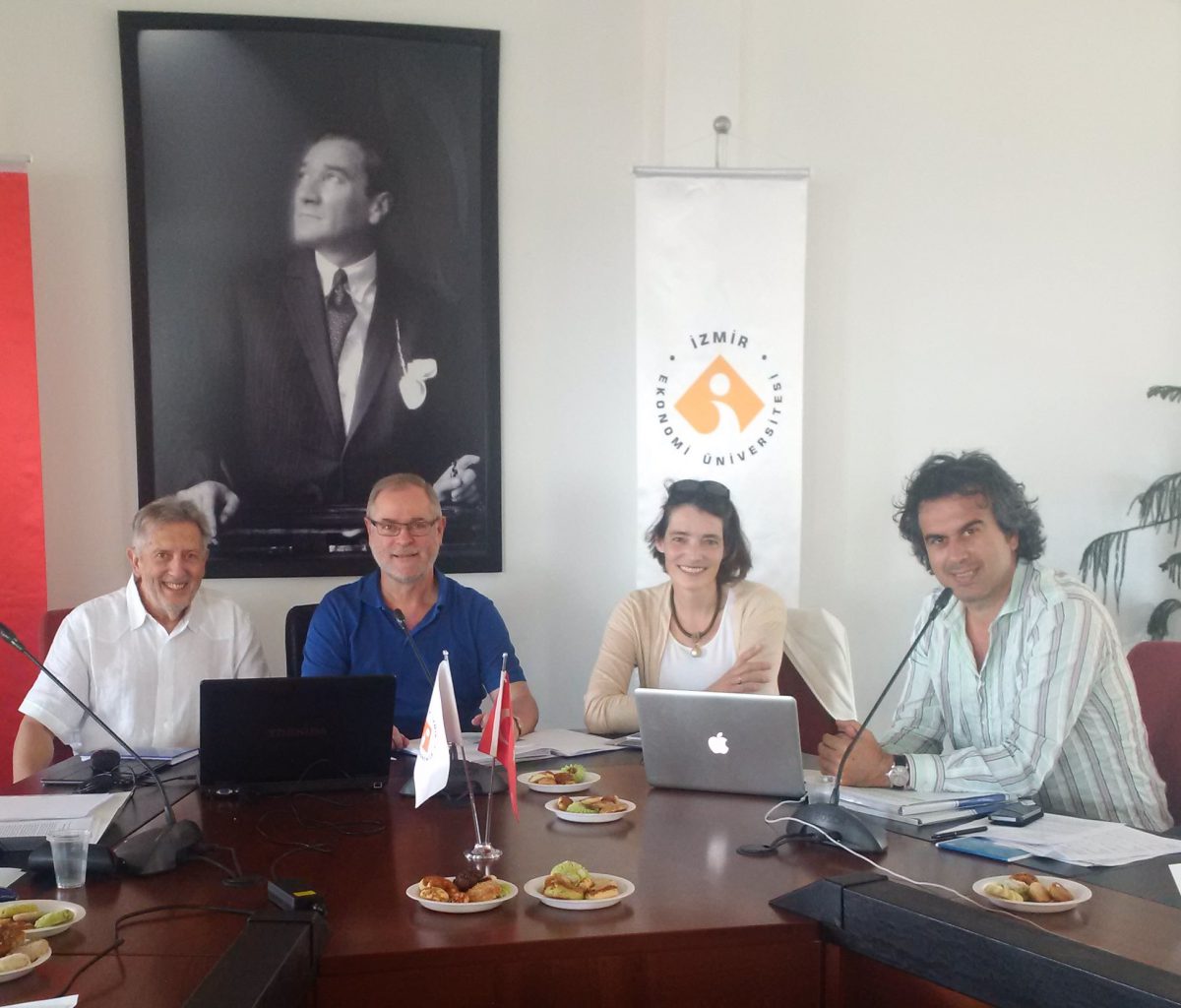
Alessandro Cigno (Editor; University of Florence), Shuaizhang Feng (Editor; Jinan University), Oded Galor (Editor; Brown University), Pierre Pestieau (Editor; Université de Liège), Erdal Tekin (Editor; American University), Katharina Wetzel-Vandai (Springer Nature), Junsen Zhang (Editor; Chinese University of Hong Kong), Klaus F. Zimmermann (Editor-in-Chief; UNU-MERIT & Maastricht University)
The Panel debate was organized to honor the contributions of Sandro Cigno to Population Economics and to the success of the Journal of Population Economics. Cigno celebrated his 80th birthday on December 24, 2020 and retired on December 31, 2020 from his position as Editor of the Journal. MORE DETAILS from the Panel see separate post in his honor.




4.00 – 5.00 pm CET Maastricht

Covid-19 in Issue 1/2021: Session Chair Madeline Zavodny (Managing Editor; University of North Florida)
Fabio Milani (University of California, Irvine): “COVID-19 outbreak, social response, and early economic effects: a global VAR analysis of cross-country interdependencies”
Discussion
Domenico Depalo (Bank of Italy): “True COVID-19 mortality rates from administrative data” Discussion


Fabrizio Patriarca (University of Modena and Reggio Emilia): “Identifying policy challenges of COVID-19 in hardly reliable data and judging the success of lockdown measures”
Co-authors: Luca Bonacini (University of Modena and Reggio Emilia); Giovanni Gallo (National Institute for Public Policies Analysis)
Discussion
Sergio Scicchitano (National Institute for Public Policies Analysis): “Working from home and income inequality: risks of a ‘new normal’ with COVID-19”
Co-authors: Luca Bonacini (University of Modena and Reggio Emilia); Giovanni Gallo (National Institute for Public Policies Analysis)
Discussion








END of the event

SPRINGER Website, Volume 34, issue 1, January 2021
LEAD ARTICLE
Štěpán Jurajda & Dejan Kovač: Names and behavior in a war — READLINK: https://rdcu.be/b9xkX
HOUSEHOLD
Lixing Li, Xiaoyu Wu & Yi Zhou: Intra-household bargaining power, surname inheritance, and human capital accumulation — READLINK: https://rdcu.be/b9xkY
Gigi Foster & Leslie S. Stratton: Does female breadwinning make partnerships less healthy or less stable? — READLINK: https://rdcu.be/b9xk0
MIGRATION
Jakub Lonsky: Does immigration decrease far-right popularity? Evidence from Finnish municipalities — OPEN ACCESS: PDF
Sandra V. Rozo, Therese Anders & Steven Raphael: Deportation, crime, and victimization — READLINK: https://rdcu.be/b9xlf
Cristina Bellés-Obrero, Nicolau Martin Bassols & Judit Vall Castello: Safety at work and immigration — OPEN ACCESS: PDF
COVID-19 (Springer presents all Covid-19 articles open accessible)
Fabio Milani: COVID-19 outbreak, social response, and early economic effects: a global VAR analysis of cross-country interdependencies — OPEN ACCESSIBLE; READLINK: https://rdcu.be/b9xlh
Domenico Depalo: True COVID-19 mortality rates from administrative data — OPEN ACCESSIBLE; READLINK: https://rdcu.be/b9xlj
Luca Bonacini, Giovanni Gallo & Fabrizio Patriarca: Identifying policy challenges of COVID-19 in hardly reliable data and judging the success of lockdown measures — OPEN ACCESSIBLE; READLINK: https://rdcu.be/b9xll
Luca Bonacini, Giovanni Gallo & Sergio Scicchitano: Working from home and income inequality: risks of a ‘new normal’ with COVID-19 — OPEN ACCESSIBLE; READLINK: https://rdcu.be/b9xln
KUZNETS PRIZE
2021 Kuznets Prize awarded to Yun Qiu, Xi Chen, and Wei Shi
Ends;
A new paper published online in the Journal of Population Economics finds for Norway that miscarriage as a biological shock to fertility has similar negative effects for all three children on female earnings in the short-run, while a catch up afterwards shows only for the third child.
The Global Labor Organization (GLO) is an independent, non-partisan and non-governmental organization that functions as an international network and virtual platform to stimulate global research, debate and collaboration.
Children and labor market outcomes: separating the effects of the first three children
by Simen Markussen & Marte Strøm
Published ONLINE 2020: Journal of Population Economics, scheduled for 2021. OPEN ACCESS .
Author Abstract: We use miscarriage as a biological shock to fertility to estimate the effect of the first three children on women’s and men’s labor market outcomes. For women, we find that the effect is almost the same for the first, second and third child in the short run. The reduction in female earnings in the three first years after birth is on average 28 percent for the first child, 29 percent for the second child and 22 percent for the third child. The reduction is caused by drops in labor supply at the intensive margin and the extensive margin, concentrated among women in the middle part of the income distribution. There is considerable catching up after five years, but effects of the first two children persist ten years later, although they are imprecisely estimated. For men, we find evidence of increased labor supply and earnings after the first two children. We also find indications that having the first child increases take-up of health-related welfare benefits, such as disability insurance, for women, and that having a second and/or a third child increases couple stability.
Access to the recently published Volume 34, Issue 1, January 2021.
LEAD ARTICLE OF ISSUE 1, 2021:
Štěpán Jurajda & Dejan Kovač: Names and behavior in a war — READLINK: https://rdcu.be/b9xkX
Ends;
A new paper published online in the Journal of Population Economics examined a conditional cash transfer program in Colombia to show that it leads to an improvement in the health of non-targeted individuals in treatment households in terms of both incidence and severity of illness.
The Global Labor Organization (GLO) is an independent, non-partisan and non-governmental organization that functions as an international network and virtual platform to stimulate global research, debate and collaboration.
Health spillover effects of a conditional cash transfer program
by Diana Contreras Suarez & Pushkar Maitra
Published ONLINE 2020: Journal of Population Economics, scheduled for 2021.
Free Readlink: https://rdcu.be/ccQWs
GLO Fellow Diana Contreras Suarez
Author Abstract: We use data from the Familias en Acción program in Colombia to examine the spillover or indirect effects of a conditional cash transfer program. Our results show that the program has significant spillover effects: it leads to an improvement in the health of non-targeted individuals in treatment households in terms of both incidence and severity of illness. The benefits are stronger for women and the elderly in the short run and for men in the medium run. Our analysis suggests that these spillovers are driven by increased access to information in the household that creates a public good.
Access to the recently published Volume 34, Issue 1, January 2021.
LEAD ARTICLE OF ISSUE 1, 2021:
Štěpán Jurajda & Dejan Kovač: Names and behavior in a war — READLINK: https://rdcu.be/b9xkX
Ends;
A new paper published online in the Journal of Population Economics is studying Russian immigrants in the early twentieth century USA to find high degrees of occupational segregation.
The Global Labor Organization (GLO) is an independent, non-partisan and non-governmental organization that functions as an international network and virtual platform to stimulate global research, debate and collaboration.
Identifying ethnic occupational segregation
by Dafeng Xu & Yuxin Zhang
Published ONLINE 2020: Journal of Population Economics, scheduled for 2021. Free Readlink: https://rdcu.be/ccPoZ
GLO Fellows Dafeng Xu & Yuxin Zhang
Author Abstract: Many studies consider occupational segregation among the immigrant population from a given birth country as a whole. This ignores potential ethnic heterogeneity within an immigrant population and may underestimate occupational segregation. We focus on Russian immigrants in the early twentieth century USA—then a major immigrant population with a high degree of ethnic diversity, including Russian, Jewish, German, and Polish ethnics—and study occupational segregation by ethnicity. We apply a machine learning ethnicity classification approach to 1930 US census data based on name and mother tongue. Using the constructed ethnicity variable, we show high degrees of occupational segregation by ethnicity within the Russian-born immigrant population in the USA. For example, Jews, German ethnics, and Polish ethnics were concentrated in trade, agriculture, and manufacturing, respectively. We also find evidence that Russian-born immigrants’ labor market outcomes were associated with networks measured by the spatial concentration of co-ethnics—particularly more established ones—but not by the concentrations of other ethnic groups.
Access to the recently published Volume 34, Issue 1, January 2021.
LEAD ARTICLE OF ISSUE 1, 2021:
Štěpán Jurajda & Dejan Kovač: Names and behavior in a war — READLINK: https://rdcu.be/b9xkX
Ends;
A new paper published online in the Journal of Population Economics suggests on the basis of a historical model analysis that England’s escape from the Malthusian trap was triggered by the demographic catastrophes in the aftermath of the Black Death.
The Global Labor Organization (GLO) is an independent, non-partisan and non-governmental organization that functions as an international network and virtual platform to stimulate global research, debate and collaboration.
Fertility versus productivity: a model of growth with evolutionary equilibria
by James Foreman-Peck and Peng Zhou
Published ONLINE: Journal of Population Economics, scheduled for 2021. Open Access
Author Abstract: We develop a quantitative model that is consistent with three principal building blocks of Unified Growth Theory: the break-out from economic stagnation, the build-up to the Industrial Revolution, and the onset of the fertility transition. Our analysis suggests that England’s escape from the Malthusian trap was triggered by the demographic catastrophes in the aftermath of the Black Death; household investment in children ultimately raised wages despite an increasing population; and rising human capital, combined with the increasing elasticity of substitution between child quantity and quality, reduced target family size and contributed to the fertility transition.
Access to the recently published Volume 34, Issue 1, January 2021.
LEAD ARTICLE OF ISSUE 1, 2021:
Štěpán Jurajda & Dejan Kovač: Names and behavior in a war — READLINK: https://rdcu.be/b9xkX
Ends;
The Global Labor Organization (GLO) and the Collaborating Centre for Labour Research (CU-COLLAR) at Chulalongkorn University in Thailand affiliate. The two organizations will support each other in their common missions on research and educational issues. CU-COLLAR will provide the local platform of GLO in Thailand and beyond. GLO Fellow and GLO Country Lead Thailand Ruttiya Bhula-or will head the local activities. The English website with the announcement will be available soon in January 2021.
The Global Labor Organization (GLO) is an independent, non-partisan and non-governmental organization that functions as an international network and virtual platform to stimulate global research, debate and collaboration.
The Collaborating Centre for Labour Research (CU-COLLAR) at Chulalongkorn University is dedicated to promoting cutting-edge labor researches to facilitate the implementation of policies, and to support the development of labor & socioeconomic data infrastructure and analysis to boost dialogues on labor research toward better wellbeing and decent work in an integrated and sustainable manner. The CU-COLLAR supports cooperation and partnership from a wide range of disciplines and universities with government, private sectors, employers’ representatives, workers’ representatives, international organizations, non-for-profit organizations at national and international levels. CU-COLLAR will provide the local platform of GLO at Chulalongkorn University, in Thailand and beyond.

Ruttiya Bhula-or is Associate Dean at the College of Population Studies, Chulalongkorn University, and GLO Country Lead Thailand. She will act as Head of the local GLO initiatives at CU-COLLAR.
Chulalongkorn University with its Collaborating Centre for Labour Research (CU-COLLAR) has become a supporting organization of GLO.



Ends;
The article “Walls and Fences: A Journey Through History and Economics” by GLO Fellow Victoria Vernon and GLO President Klaus F. Zimmermann is now published.
Walls and Fences: A Journey Through History and Economics – Download PDF
by Vernon, Victoria & Zimmermann, Klaus F.
GLO Discussion Paper No. 330: 2019
Pre-publication version.
In: Kourtit, K., Newbold, B., Nijkamp, P., Partridge, M. (Eds.), The Economic Geography of Cross-Border Migration, pp. 33-54. Published.
Throughout history, border walls and fences have been built for defense, to claim land, to signal power, and to control migration. The costs of fortifications are large while the benefits are questionable. The recent trend of building walls and fences signals a paradox: In spite of the anti-immigration rhetoric of policymakers, there is little evidence that walls are effective in reducing terrorism, migration, and smuggling. Economic research suggests large benefits to open border policies in the face of increasing global migration pressures. Less restrictive migration policies should be accompanied by institutional changes aimed at increasing growth, improving security and reducing income inequality in poorer countries.
Ends;