Posted inGlobal Insights, News, Policy|Comments Off on Global Insights – Für eine allgemeine #Corona-#Impfpflicht und eine langfristige #Impfstrategie.
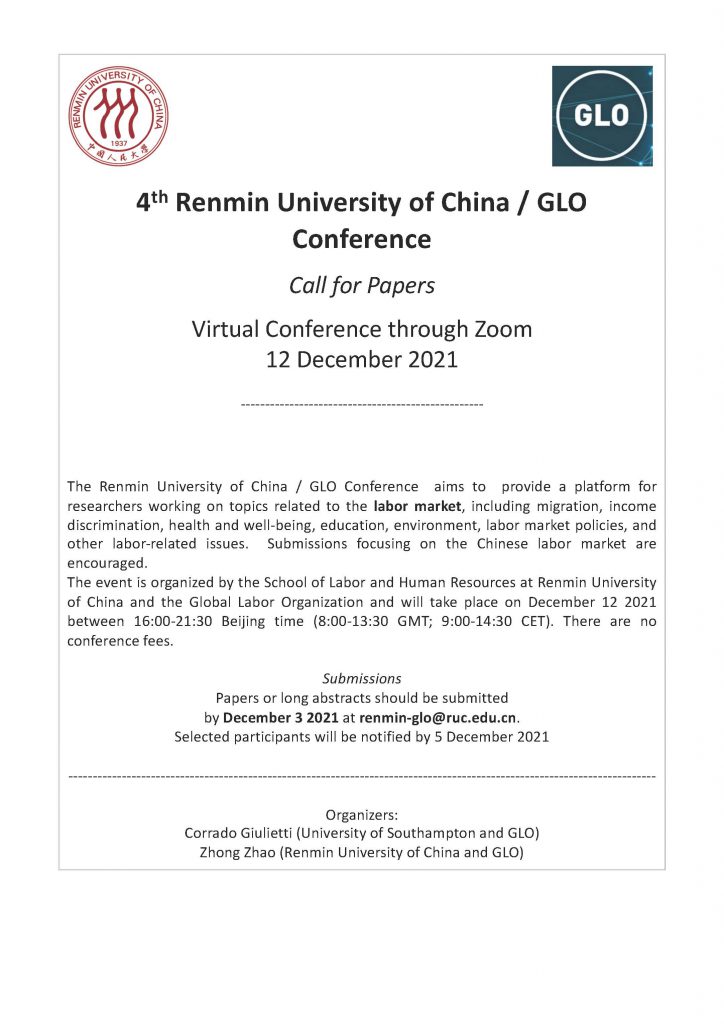
The 4th Renmin University of China & GLO Conference 2021 takes place online in Beijing on December 12 organized by the School of Labor and Human Resources together with GLO. Topics covered will deal with Chinese labor market issues.
Author Abstract: Gender disparities in STEM fields participation are a major cause of concern for policymakers around the world. In addition to talent misallocation, low female enrollment rates in STEM careers contribute to gender-based inequalities in earnings and wealth, given the higher average level of earnings in these fields. This paper studies the effects of exposure to role models on female preferences for STEM majors. We conduct a randomized control trial where female senior students currently enrolled in engineering programs at an elite private university in Peru give talks about their experiences at randomly selected high schools. We find that exposure to this treatment increases high ability female students’ preferences for engineering programs by 14 percentage points. The effect is only statistically significant for the subgroup of female students with baseline math scores in the top 25 percentile, and who reside close to the city where the role models’ university is located. We also find positive but smaller effects on “low ability” male students. In a context where females are discouraged from enrolling in STEM fields, our results have important policy implications.
The Global Labor Organization (GLO) is an independent, non-partisan and non-governmental organization that functions as an international network and virtual platform to stimulate global research, debate and collaboration.
Author Abstract: This paper reviews studies on LGBT workplace outcomes published between 2015 and 2020. In terms of earnings differences, in the US, Canada, Europe, and Australia, gay men were found to experience earnings penalties of 7% in comparison to heterosexual men, bisexual men experienced earnings penalties of 9% in comparison to heterosexual men, and bisexual women faced earnings penalties of 5% in comparison to heterosexual women. In the same regions, lesbian women experienced an earnings premium of 7% in comparison to heterosexual women. Trans women, in the US and Europe, faced earnings penalties ranging from 4% to 20%. In terms of job satisfaction, in the US, Canada, and Europe, gay men, and lesbian women experienced 15% and 12%, respectively lower job satisfaction than their heterosexual counterparts. Additionally, bullying against sexual minorities has persisted. In the UK, sexual minorities who experienced frequent school-age bullying faced a 32% chance of experiencing frequent workplace bullying. In relation to job exclusions, in OECD countries, gay men and lesbian women were found to experience 39% and 32%, respectively lower access to occupations than comparable heterosexual men and women. For trans men and women in Europe, comparable patterns are in evidence. Given these patterns, it is not of surprise that LGBT people in the US and the UK experience higher poverty rates than heterosexual and cis people. However, in these two regions, anti-discrimination laws and positive actions in the workplace helped reduce the earnings penalties for gay men, enhance trans people’s self-esteem, spur innovation and firms’ performance, and boost marketing capability, corporate profiles, and customer satisfaction. The evidence indicated that LGBT inclusion and positive economic outcomes mutually reinforced each other.
The Global Labor Organization (GLO) is an independent, non-partisan and non-governmental organization that functions as an international network and virtual platform to stimulate global research, debate and collaboration.
Author Abstract: This paper examines a problem of worker misallocation into jobs. A theoretical model, allowing for heterogeneous workers and firms, shows that job search frictions generate mismatch between employees and employers. In the empirical analysis, the British Household Panel Survey (BHPS), the UK household Longitudinal Study (UKHLS) and British Cohort Study 1970 (BCS70) data are used to measure the incidence of mismatch, how it changes over time and whether it can be explained by unobserved ability. Results show that (i) the incidence of mismatch increases after the Great Recession. (ii) Individual transitions to/from matching take place due to workers’ occupational mobility and over-time skills development. (iii) Employees can find better jobs or their mobility occurs earlier than the aggregate change of skills. (iv) Controlling for individual heterogeneity, measured by cognitive and non-cognitive skill test scores throughout childhood, does not decrease the incidence of mismatch. This suggests that unobserved productivity does not generate mismatch in the labour market.
The Global Labor Organization (GLO) is an independent, non-partisan and non-governmental organization that functions as an international network and virtual platform to stimulate global research, debate and collaboration.
A new GLO Discussion Paper finds that education played a protective role, significantly reducing mortality rates, during the first wave of the pandemic (between March and May 2020), but not during the second wave (between October and December 2020).
Author Abstract: We study the role of education during the COVID-19 epidemic in Italy. We compare the trends of mortality rates between municipalities with different shares of educated residents between 2012 and 2020, by means of a continuous event study model and controlling for many confounders. We find that education played a protective role, significantly reducing mortality rates, during the first wave of the pandemic (between March and May 2020), but not during the second wave (between October and December 2020). We tentatively interpret this finding as the outcome of the interplay between education and public health communication, whose coherence and consistency varied between the different stages of the epidemic.
The Global Labor Organization (GLO) is an independent, non-partisan and non-governmental organization that functions as an international network and virtual platform to stimulate global research, debate and collaboration.
A new GLO Discussion Paper shows that women appear to be more sensitive to the effect of the pandemic, and report much higher levels of anxiety and depression than males.
Author Abstract: This paper assesses the impact of the Covid-19 lockdown measures on the mental health of individuals in the UK, starting from the early restrictions in April 2020, and covering three subsequent lockdowns, up until March 2021. It also considers three aspects of mental health; that is ‘anxiety and depression’, ‘social dysfunction’, and ‘loss of confidence’, in order to identify which specific dimensions of respondents’ psychology have been adversely affected. Our findings show that women appear to be more sensitive to the effect of the pandemic, and report much higher levels of anxiety and depression than males; whilst social dysfunction appears to be a more permanent fixture. Initially, social dysfunction was higher for women and younger workers, but it remained high for women and the over 55s. Consequently, our evidence supports targeted policies aimed at reducing social isolation for women and older workers. Finally, we show that financial difficulties had a growing impact on all mental health outcomes, as the pandemic progressed.
The Global Labor Organization (GLO) is an independent, non-partisan and non-governmental organization that functions as an international network and virtual platform to stimulate global research, debate and collaboration.
A new GLO Discussion Paper finds small but statistically significant detrimental effects on labor market outcomes of Vietnam veterans residing in unauthorized Chinese enclaves in 1990.
Author Abstract: The role of ethnic immigrant networks in facilitating international trade is a well-established phenomenon in the literature. However, it is less clear whether this relationship extends to illegal trade and unauthorized immigrants. In this paper, we tackle this question by focusing on the case of the heroin trade and unauthorized Chinese immigrants in the early 1990s United States. Between mid-1980s and mid-1990s, Southeast Asia became the dominant source of heroin in the US. Heroin from this region was trafficked into the US by Chinese organized criminals, whose presence across the country can be approximated by the location of unauthorized Chinese immigrants. Instrumenting for the unauthorized Chinese immigrant enclaves in 1990 with their 1900 counterpart, we first show that Chinese presence in a community led to a sizeable increase in local opiates-related arrests, a proxy for local heroin markets. This effect is driven by arrests for sale/manufacturing of the drugs. Next, we examine the consequences of Chinese-trafficked heroin by looking at its impact on US Vietnam-era veterans – a group particularly vulnerable to heroin addiction in the early 1990s. Using a triple-difference estimation, we find mostly small but statistically significant detrimental effects on labor market outcomes of Vietnam veterans residing in unauthorized Chinese enclaves in 1990.
The Global Labor Organization (GLO) is an independent, non-partisan and non-governmental organization that functions as an international network and virtual platform to stimulate global research, debate and collaboration.
A new GLO Discussion Paper finds for Turkey that increasing the minimum wage reduces the employment probability of young males first but school enrollment increases over time and absorbs the negative employment effect.
Author Abstract: We exploit an age-specific minimum wage rule – which sets a lower minimum wage for workers of age 15 than the adult minimum wage paid to workers of age 16 and above – and its abolition to estimate the causal effect of a minimum wage increase on youth employment and education in Turkey. Using a regression discontinuity design in tandem with a difference-in-discontinuities analysis, we find that increasing the minimum wage reduces the employment probability of young males by 2.5-3.1 percentage points. We also document that, initially, the minimum wage increase does not lead to a major change in high school enrollment, while the likelihood of transitioning into “neither in employment nor in education and training” (NEET) category notably increases. However, in the medium term, the NEET effect is transitory; school enrollment increases over time and absorbs the negative employment effect. We argue that policy effects have mostly been driven by demand-side forces rather than supply side.
The Global Labor Organization (GLO) is an independent, non-partisan and non-governmental organization that functions as an international network and virtual platform to stimulate global research, debate and collaboration.
Posted inNews, Research|Comments Off on The impact of age-specific minimum wages on youth employment and education: A regression discontinuity analysis
A new GLO Discussion Paper finds that hiring discrimination against candidates with disabilities, older candidates, and less physically attractive candidates is at least equally severe as the unequal treatment of candidates with salient racial or ethnic characteristics.
Author Abstract: Notwithstanding the improved integration of various minority groups in the workforce, unequal treatment in hiring still hinders many individuals’ access to the labour market. To tackle this inaccessibility, it is essential to know which and to what extent minority groups face hiring discrimination. Past meta-studies have charted parts of the discrimination literature but permit only limited comparisons across minority groups. This meta-analysis synthesises a quasi-exhaustive register of correspondence experiments on hiring discrimination published between 2005 and 2020. Using a random-effects model, we computed pooled discrimination ratios concerning a total of ten discrimination grounds upon which unequal treatment in hiring is forbidden under United States federal or state law. First, we find that hiring discrimination against candidates with disabilities, older candidates, and less physically attractive candidates is at least equally severe as the unequal treatment of candidates with salient racial or ethnic characteristics. Remarkably, hiring discrimination against older applicants is even higher in Europe than in the United States. Furthermore, unequal treatment in hiring based on sexual orientation seems to be prompted mainly by signalling activism through an affiliation with an LGB+ rights organisation rather than same-sex orientation in itself. Last, hiring discrimination remains pervasive. Aside from a decrease in hiring discrimination based on race and national origin in Europe, we find no structural evidence of temporal changes in hiring discrimination based on the various other grounds within the scope of this review.
The Global Labor Organization (GLO) is an independent, non-partisan and non-governmental organization that functions as an international network and virtual platform to stimulate global research, debate and collaboration.