
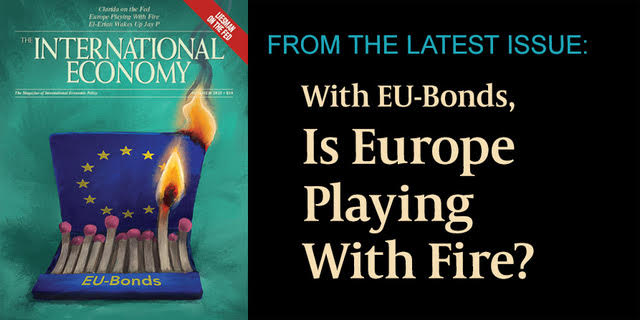
Is Europe Playing With Fire? Nearly two dozen noted observers offer their views on EU-Bonds in the latest issue of The International Economy. The magazine of international economic policy. (For a free link to the entire debate see below.) GLO President Klaus F. Zimmermann was invited to contribute to the discussion:
Expanding EU-level issuance is justifiable
by Klaus F. Zimmermann
Public debt in the euro area is high and continues to rise significantly, necessitating a cautious, rules-based approach. Eurostat has reported that the euroarea’s debt ratio stood at 88 percent of GDP in early 2025, with the entire European Union at about 82 percent. There is considerable variation among member countries. Given the current global economic, financial, and political climate, it is anticipated that aggregate debt will increase substantially over the medium term under various plausible scenarios. Consequently, it is essential to rebuild fiscal buffers while simultaneously prioritizing investments that enhance potential growth and maintain support for Ukraine as a European public good.
A novel approach to fiscal management and market liquidity is achievable, though it should remain narrowly focused in the short term. Under the European Commission’s “unified funding” model, the European Union issues pooled “EU-Bonds” under a single label and adheres to semi-annual funding plans. Eurex, the main European derivatives exchange owned by Deutsche Börse, has recently introduced physically deliverable futures on EU-Bonds, offering investors a standardized method to hedge against fluctuations in EU-Bond yields. Provided that issuance remains predictable and transparent, these contracts are expected to enhance secondary market liquidity by connecting cash, repo, and derivatives markets.
Legally, EU-issued securities are obligations of the Union that are used to finance EU programs. The EU budget must be in balance, Article 310 of the Treaty on the Functioning of the European Union requires that revenue and expenditure match. While short-term borrowing on capital markets has been authorized, these liabilities must be repaid in full and in sequence. This approach is distinct from taking on member state legacy debts, highlighting the importance of keeping EU borrowing tied to specific programs and time-limited. Deviating from this approach would not align with European treaties.
Germany has not abolished its debt brake but has constitutionally narrowed it. In March 2025, the Bundestag and Bundesrat approved exemptions for defense expenditures exceeding roughly 1 percent of GDP and established a substantial, multi-year infrastructure special fund. From a conservative standpoint, this approach heightens execution risk and necessitates credible medium-term consolidation. Current experiences already reveal displacement effects: transfers from the core budget into the new fund have created space for non-investment consumption items, effectively crowding out net new public infrastructure efforts and undermining the reform’s stated intent. This dynamic highlights the significant risks associated with the chosen approach and underscores the importance of firm guardrails.
Therefore, expanding EU-level issuance is justifiable for well-defined European public goods, such as defense readiness (including ongoing support for Ukraine), energy security, single-market deepening, and climate-critical infrastructure, as long as it is grounded in transparent program law, strict conditionality, and repayment plans within the European Union’s seven-year long-term budget. With these safeguards, deeper EU issuance and the new futures market can enhance liquidity and resilience without obscuring sovereign-risk pricing; without them, mutualization would invite moral hazard and undermine market credibility.
Expanding EU-level issuance is justifiable. in: The International Economy. The magazine of international economic policy, With EU-Bonds, Is Europe Playing With Fire?, Summer 2025, pp. 46-47. Contribution by Klaus F. Zimmermann. LINK to the complete published material.
Ends;